Hips · should I…?
The hidden cost of waiting for hip replacement surgery
Tanya went from constant, awful pain to nearly pain-free without surgery. She’s still deciding what to do next, and her situation shows exactly why that decision is more complicated than “wait until it’s bad enough.”
Licensed orthopedic physical therapist with 30 years of clinical experience, former owner of an
orthopedic PT clinic, and author of the Fixing You book series, including
Fixing You: Hip & Knee Pain and the award-winning Pain Patterns
(2025 NIEA Award winner). He created an APTA-approved continuing education course teaching other
clinicians his systems-thinking approach to chronic pain.
Most advice about hip replacement comes down to one sentence: wait until the pain is bad enough, then have the surgery. It treats the decision as though only one joint is involved, when the rest of your body is often paying a price while you wait.
The advice almost everyone gets, and why it’s incomplete
If you have hip osteoarthritis, you’ve probably heard some version of this from your surgeon: keep going until the pain is bad enough to justify replacing the joint. It’s reasonable advice from where they sit. A hip replacement has a lifespan, and nobody wants to use it up too early.
But for a lot of people that advice translates to: how long can I hold out? And once that’s the goal, something else starts happening that most surgeons aren’t trained to watch for.
Always follow your medical team’s guidance for your specific case. This article isn’t a reason to delay a surgery your doctor has recommended, and it isn’t a diagnosis. It’s a systems-level view of what else may be happening in your body while you decide.
Watch the video version
I answer this exact question — Tanya’s, and another viewer’s, Sharon’s — in this Q&A.
Tanya’s story: constant pain to nearly pain-free, still deciding
Tanya has bilateral hip arthritis, worse on the left. Her X-ray showed a flattened femoral head and subchondral cysts. Before finding my program, she was in constant, awful pain day and night, walking with a limp, and had consulted a surgeon who felt her hip was likely too damaged for a simpler resurfacing procedure and would need a full replacement.
She worked through my home program. The result: she’s now mostly pain-free except with some weight-bearing activities like stairs, sleeps comfortably on either side for the first time in years, and still has a slight limp. She hasn’t fully resolved everything — she still can’t fully abduct either leg, and she’s still deciding whether to move forward with surgery.
— Rick’s case notes
I’m not writing this to talk Tanya, or you, out of surgery. Her situation is a useful example precisely because it isn’t fully resolved. It shows what progress without surgery can look like, and it shows that correcting the mechanics first doesn’t always mean you’ll never need the operation. Sometimes it means you go into that decision from a much better starting point: less pain, improved function, and a clearer picture of what’s driving what.
Should I wait, or have hip replacement surgery now?
There’s no universal answer, and you should always defer to your medical team on your specific case. But before deciding, it helps to know two things most people aren’t told.
First: structural findings — worn cartilage, a labral tear, bone-on-bone contact — don’t automatically explain your pain. Imaging studies show labral tears and cartilage defects at similar rates in hips with and without pain.1 I’ve had patients scheduled for surgery who, after correcting an underlying movement pattern, no longer needed it. A published case series on this exact pattern found patients achieved complete symptom resolution with conservative treatment alone.2
Second: waiting isn’t free. It has a cost of its own.
The hidden cost of waiting
Once “hold out as long as possible” becomes the plan, most people start compensating — limping, favoring the leg subtly, avoiding stairs — without realizing those often subconscious decisions play out somewhere else. They land in the rest of your body, and how much damage that does depends heavily on how prepared that part of your body is to absorb it.
Here’s what I see, in rough order of how well it’s documented.
The opposite knee
People who have a hip replaced for one-sided hip osteoarthritis are more likely to later need their opposite knee replaced than the knee on the same side, and that opposite knee carries measurably more load when they walk, even before hip surgery.3
The opposite hip
In my clinical experience, the same asymmetric loading that stresses the opposite knee often extends up into the opposite hip as well.
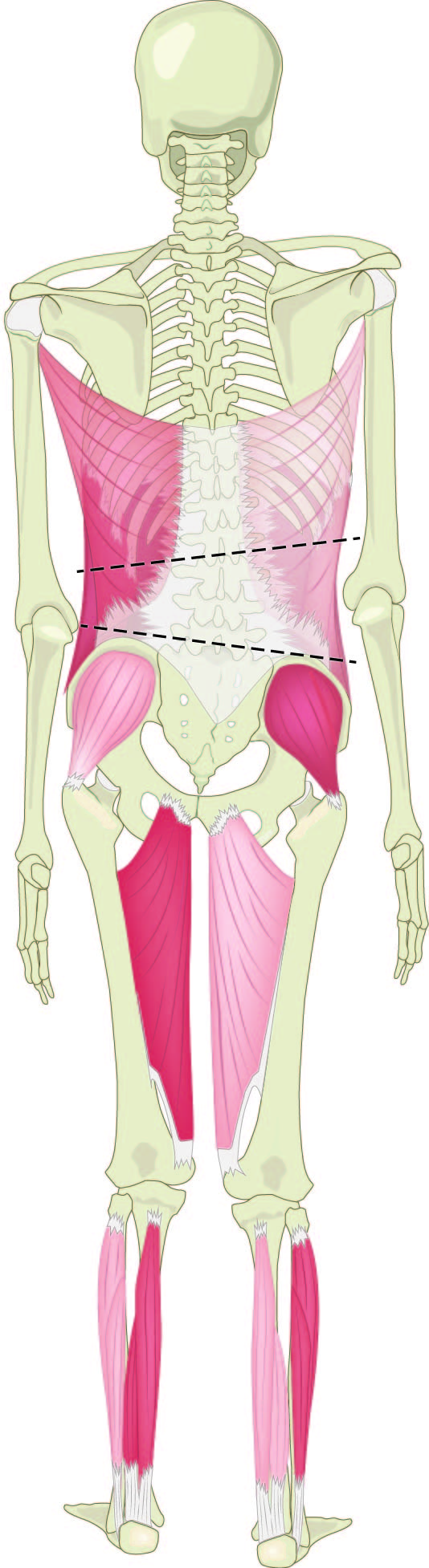
A sidebending problem, and from there, the back and sciatic nerve
Limping shifts your weight unevenly through the pelvis and spine. I’ve seen this create what I call a sidebending problem — an uneven pelvis and rib cage — which feeds directly into back pain and sciatica. I cover this pattern in full depth, including the test and the fix, in my sciatica article. I had one patient with a hip labral tear whose new left-sided back pain traced directly back to this: he’d started weight-bearing more heavily on his healthy leg to protect the torn hip, and that left side began breaking down as a result. (Watch that case.)
The opposite ankle and foot, including plantar fasciitis
You won’t find this one in the research. Plantar fasciitis studies focus on foot mechanics, overpronation, or a tight calf — not on overload from a hip on the other side of the body. That’s simply outside what that research is designed to measure. But clinically, I’ve seen this many times: the “good” foot breaking down because it’s been doing double duty for months. I cover the foot side of this in my plantar fasciitis article.
And waiting itself
One study found that hip replacement patients who waited longer than six months after referral had greater disability going in, and realized smaller gains in quality of life and mobility afterward, than patients who had surgery sooner.4 This could point to the compensations compounding over time.
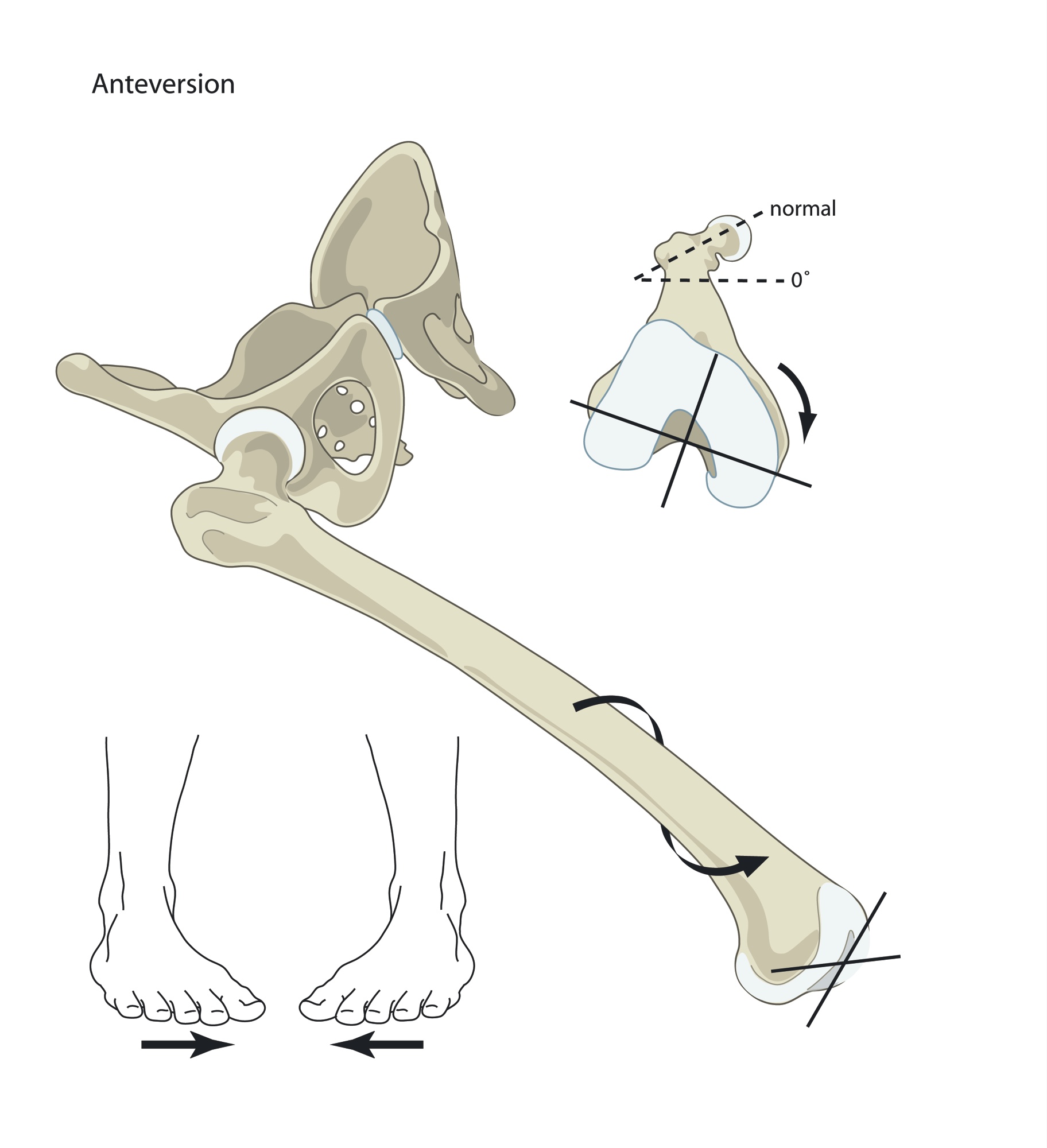
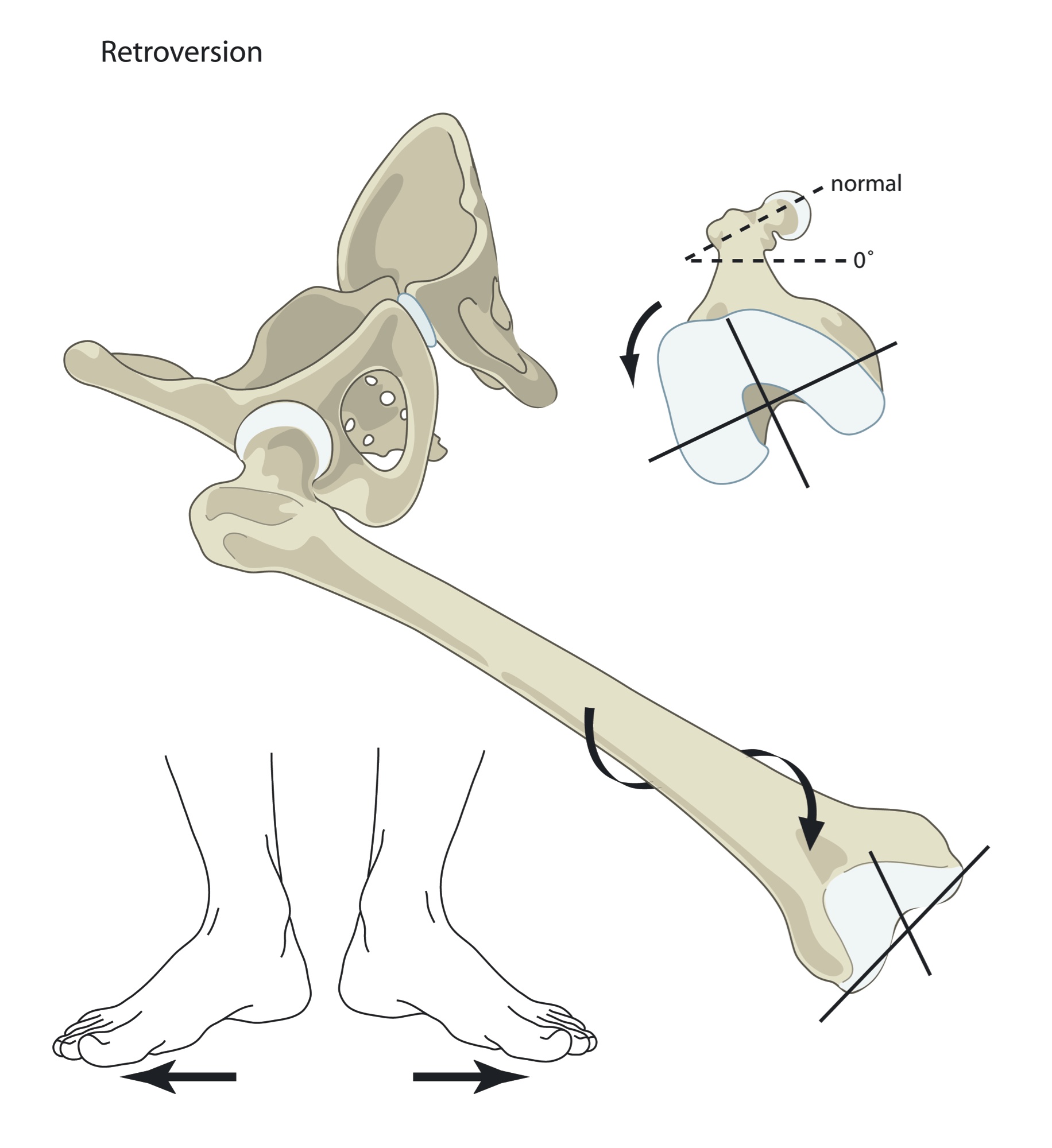
How much all of this matters also depends on something I haven’t covered yet in this series: the shape of your thigh bone. Femoral anteversion and retroversion describe the natural rotation of the thigh bone, inward or outward, and either can deliver significant stress to the hip and knee if your movement strategy doesn’t account for it. This isn’t because femoral version is a problem — it’s because how you use your body should differ depending on which shape you have. It’s important enough that I’ve devoted the last article in this series to it.
Why your doctor won’t catch this
This gets into the division of jobs in healthcare. A surgeon’s job is to be excellent at replacing a hip joint — evaluating the joint, planning the surgery, executing it well. That’s a lot of responsibility and a valuable skill. Their job isn’t to track what months of weight shifting does to your opposite knee, your back, or your foot. That’s a physical therapist’s job.
When conservative treatment hasn’t changed the pain, the assumption is often that everything possible has already been tried. In my arthroscopic surgery article, I go into why that assumption doesn’t always hold, and why conservative care often stops short of addressing the movement pattern actually driving the pain.
Surgery also doesn’t automatically undo the compensations, or the mechanics that helped create the problem in the first place. Research using EMG has found abnormal glute activation patterns persisting after hip replacement, sometimes for years,5 and a large long-term study found moderate-to-severe pain in 8.1% of patients two years after primary hip replacement, rising to 10.8% at five years.6 The joint gets replaced. The pattern that helped wear it out doesn’t automatically go with it.
A better framework than “wait until it’s bad enough”
Try this instead
Four steps, whether or not you’re facing this decision now
- Spend a few focused weeks correcting the underlying movement pattern. I walk through the specific pattern, self-test, and fix behind most hip pain in the first article in this series.
- Check how your other leg is holding up. Are you limping? Is your “good” knee, hip, back, or foot starting to complain too? The compensation test I cover in my knee pain article is built exactly for this — it reveals which leg your brain has been quietly favoring, whether or not that leg hurts yet. That’s information your surgeon isn’t going to ask you about, but it should inform your decision.
- Reassess. If your pain and function meaningfully improve — the way they did for Sylvia in the first article, and largely for Tanya — you may be able to delay surgery on your own terms rather than your pain’s terms, while protecting the rest of your body in the meantime.
- If it doesn’t change much, surgery is a reasonable, informed choice. You’ll go into it having already reduced some of the mechanical stress on the joint, with less accumulated compensation elsewhere in your body.
That’s the value of a systems perspective. Sometimes it doesn’t hand you an answer you necessarily want, but it makes sure the decision accounts for your whole body, not just the one joint that hurts the most right now. Most medical training simply doesn’t include that perspective, which is exactly the gap I built my practice around.
Rick’s takeaway
“Wait until it’s bad enough” quietly assumes the waiting is free. It isn’t. Every month of limping is teaching the rest of your body a pattern it will keep after the joint is replaced — so use the waiting time to fix the mechanics, not just to endure.
In the next article, I explain femoral anteversion and retroversion — a potentially huge stressor to your hips that almost no one ever checks, and how to work with it.
Common questions
I’ve already been limping for months trying to avoid surgery. Is the damage to my other leg already done?
Not necessarily — check rather than assume. In my experience the compensating leg usually has capacity left. The sooner you address both the hip pattern and how the other leg has been absorbing load, the more of that capacity you protect.
How long can you safely wait for a hip replacement?
There isn’t a universal number of months that’s safe for everyone. The more useful question is what happens to your pain, function, mobility, and compensatory patterns while you wait — which is exactly what this article walks through.
Can physical therapy delay hip replacement surgery?
Sometimes. If symptoms and function improve enough, some people choose to postpone surgery, the way Tanya has. Physical therapy isn’t guaranteed to eliminate the need for replacement when the joint is severely compromised, but it can change the timeline, and the starting point you go into surgery from.
If I have surgery, will the compensation in the rest of my body resolve on its own afterward?
Not automatically. The hip joint changes, but the movement patterns that developed while you were compensating don’t necessarily go with it, because they’re subconscious. This is exactly why I recommend addressing them whether or not surgery is in your future.
My doctor didn’t mention anything about my other leg or my back. Should I be concerned they missed something?
No. This genuinely falls outside a surgeon’s scope of training — not because they’re not thorough, but because their expertise is the joint and the operation itself. Raise it with a clinician trained to look at the whole system, alongside your surgical care rather than instead of it.
Is there a way to test whether my “good” leg is compensating before it becomes a real problem?
Yes. This is exactly what I built into my home programs and Pain Patterns: a way to check how well-prepared the uninvolved side is, rather than waiting for it to start hurting on its own.
I have bilateral hip arthritis, like Tanya. Does any of this still apply?
Yes, though the compensation pattern looks a little different. You may be shifting more toward the less-affected hip rather than a fully uninvolved leg. The same principle holds: check how that side is handling the extra load rather than assuming it’s fine.
Does correcting this pattern guarantee I can avoid surgery?
No, and I wouldn’t want to promise that. Some people, like Sylvia, avoid it. Others, like Tanya, make significant progress but may still choose surgery. Either way, you’re making a more informed decision than “wait until it’s unbearable.”
If you’re weighing this decision right now
Correct the mechanics first, then decide
7 Days to Better Hips is built on the same approach I used with Sylvia and Tanya — including the pain-reduction phase most people skip past too quickly on their way to more advanced exercises.
Explore 7 Days to Better Hips
Want the systems-level view in full? Pain Patterns includes the free assessment tool and goes further into this kind of decision-making than any single article can.
Some links in this article are affiliate links. If you buy through them I may earn a small commission, at no extra cost to you. I only recommend products I actually use with patients.
Have a question this article didn’t answer?
Send it through the Ask Rick form. I read every question and use the most common ones to shape future articles, videos, and my monthly email — sometimes by featuring them, never with identifying details, in a public answer. I ask for your email in case I need more detail, or want to let you know when I’ve covered it.
References
- Heerey JJ, Kemp JL, Mosler AB, et al. “What Is the Prevalence of Hip Intra-Articular Pathologies and Osteoarthritis in Active Athletes with Hip and Groin Pain Compared with Those Without? A Systematic Review and Meta-Analysis.” Sports Medicine. 2019. ↩
- Grant C, Pajaczkowski J. “Conservative Management of Femoral Anterior Glide Syndrome: A Case Series.” Journal of the Canadian Chiropractic Association. 2018;62(3):182–192. ↩
- Shakoor N, Block JA, Shott S, Case JP. “Nonrandom evolution of end-stage osteoarthritis of the lower limbs.” Arthritis & Rheumatism. 2002;46(12):3185–3189. Of patients who needed a knee replaced after a hip replacement for osteoarthritis, most had the knee on the opposite side replaced. See also Shakoor N, Hurwitz DE, Block JA, Shott S, Case JP. “Asymmetric knee loading in advanced unilateral hip osteoarthritis.” Arthritis & Rheumatism. 2003;48(6):1556–1561, which found higher loading in the opposite knee during walking, before and after hip replacement. ↩
- Garbuz DS, Xu M, Duncan CP, Masri BA, Sobolev B. “Delays Worsen Quality of Life Outcome of Primary Total Hip Arthroplasty.” Clinical Orthopaedics and Related Research. 2006;447:79–84. ↩
- May MC, Zanirato A, Puce L, Giannarelli E, Trompetto C, Marinelli L, Formica M. “Electromyography After Total Hip Arthroplasty: A Systematic Review of Neuromuscular Alterations and Functional Movement Patterns.” Journal of Clinical Medicine. 2026;15(1):400. ↩
- Singh JA, Lewallen D. “Predictors of Pain and Use of Pain Medications Following Primary Total Hip Arthroplasty (THA): 5,707 THAs at 2-Years and 3,289 THAs at 5-Years.” BMC Musculoskeletal Disorders. 2010;11:90. Moderate to severe pain was reported by 8.1% of patients at two years, rising to 10.8% at five years. ↩