Knees
Why your knee pain might not actually be a knee problem
Almost every muscle controlling the knee comes down from the hip or crosses up from the foot. Treating the knee in isolation misses where the problem usually starts.
Licensed orthopedic physical therapist with 30 years of clinical experience, former owner of an
orthopedic PT clinic, and author of the Fixing You book series, including
Fixing You: Hip & Knee Pain and the award-winning Pain Patterns
(2025 NIEA Award winner). He created an APTA-approved continuing education course teaching other
clinicians his systems-thinking approach to chronic pain.
Most knee pain advice focuses on the knee itself: strengthen the quad, ice it, stretch the hamstrings, maybe get an injection. But almost everything controlling the knee comes from above or below it, the hip or the foot, which means the real problem is often somewhere else entirely, maybe even in the other leg.
Scheduled for four joint replacements, one at a time
Denise. Her doctor found significant wear and tear in her left hip and recommended a hip replacement. When she finally saw the surgeon, he went further: both hips, both knees, a curve in her spine, and a leg length discrepancy. The plan was staged replacements, one joint at a time, starting with the worst hip.
She scheduled the surgery. Then, before her surgery date, she found a program built around a different idea: that her hip pain, the “leg length discrepancy,” and the curve in her spine were connected, and that the connection itself was the problem, not four separate joints wearing out independently.
She worked through the hip pattern. Her apparent leg length difference and spinal curve, which turned out to be a functional rather than a fixed curve, both changed once her hip mechanics improved. And her knee, which she’d assumed would need its own separate fix, improved right along with everything else.
“The knee was a bonus. I wasn’t expecting it to heal my knee at all. It was all about having a better hip.”
— Denise
Watch the full conversation: How did somatics help Denise’s knee pain?
Always follow the guidance of your medical team. What follows isn’t a diagnosis. It’s a framework for understanding why knee pain so often doesn’t resolve when treatment focuses on the knee alone, and why it’s rarely just about the knee.
Watch the video version
The three most common causes of knee wear and tear that most people never hear about.
Why does my knee pain keep coming back?
The knee is caught between two much larger structures: the hip above it and the foot below it. Neither the hip nor the foot has to be painful to stress the knee. Poor control is enough.
Here’s why the knee absorbs so much of that stress. The knee joint already has a small amount of rotation built into it: the femur’s two condyles, the rounded ends that meet the shin bone, are shaped and sized differently, so the knee naturally rotates slightly as it moves between bent and straight. That rotation is a normal, designed part of how the joint works. The problem is that it doesn’t leave much spare room. When the thigh bone above adds more rotation, from femoral anteversion or retroversion or from glutes that aren’t controlling that rotation well, or the foot below adds more rotation, from overpronation or supination or tight calf and soleus muscles, the knee has the least room of the three joints to absorb the extra load without paying for it.
That makes the knee something more than just a hinge joint that can hurt. It’s the linchpin connecting your foot, your hip, your pelvis, and your back into one system. This article briefly walks through the hip and foot sides of that equation, then ends with a test that often reveals a deeper problem potentially causing your knee pain.
The hip connection
Quick take: The shape of your thigh bone, and how well your glutes control it, changes how much rotational stress reaches your knee with every step.
Some thigh bones are naturally rotated inward (femoral anteversion), some outward (femoral retroversion). Neither shape is a problem by itself, but an anteverted femur can increase the rotational demands placed on the knee, particularly when the glutes aren’t controlling the thigh well. I recommend you do the self-test for this and then see what to do about each shape, anteversion or retroversion, which I cover in a separate article in the hip series, since it applies just as much to knee pain as it does to hip pain.
Glute control matters because when they aren’t stabilizing the hip well during walking, a common pattern I cover in depth in the first hip article in this series, the thigh bone gets sloppy in the hip socket. That drift transmits rotational stress down into the knee. Hip strength deficits are well documented in people with symptomatic knee osteoarthritis, though the research can’t yet say whether the weakness came first or developed alongside the joint damage.1
Watch the gait pattern that turns your glutes back on →
The foot connection
Quick take: An overpronated (flat) foot rotates the lower leg bone inward with every step, adding to whatever rotational stress is already coming from above.
When the foot pronates excessively, the theory goes that it drives a corresponding internal rotation of the tibia, the lower leg bone, as it moves up into the knee. The evidence for this exact chain is mixed. Some studies have found the mechanical link between foot pronation and knee pain; others, comparing people with and without patellofemoral pain, haven’t found the expected differences in tibial rotation.2 In my opinion, this may have something to do with untested femoral anteversion or retroversion confounding the testing. I still find it a useful piece to check clinically, particularly alongside the hip factors above.
Tight calf and soleus muscles play into this too: restricting how far your ankle can bend forward (dorsiflexion) forces something else in the chain to move instead. Research simulating this restriction during a squat found it produced increased knee valgus (the knee collapsing inward), decreased quadriceps activation, and increased soleus activation, changes similar to what’s seen in patellofemoral pain.3 I cover the specific test for this in my foot and ankle article.
Is there a bigger problem causing your knee pain?
Quick take: This test doesn’t measure your knee, your hip, or your foot specifically. It measures which side of your body your brain trusts more, which is often the opposite of what you’d guess.
Most single leg testing looks for one specific thing: does the knee cave inward, referred to as knee valgus. While that’s useful, it’s a much smaller framing of a potentially larger problem: why one side of your body may be working harder than the other. All you’ll need is a chair and a phone to figure this out.
Interpreting this test is so important that I’m not even going to explain the results in this article. Instead you can watch my YouTube video to decipher your results. This is because understanding the reasoning behind the test changes how you perform the test, which defeats the purpose. The explanation is one video link away, and it’ll still be there when you’re done with the test.
Try this test
The compensation test
Before you start, set up a phone or camera to record yourself from the front, standing far enough back to catch your whole body.
- Find a chair, stool, couch, or table you can stand up from and sit back down on using just one leg.
- Pick a height that is challenging to do this with one leg. Adjust with books or a pillow if you need to. Take your best guess at that height and commit to it. Do not do practice repetitions to dial in the “right” height. We want only one repetition. Trial and error changes the result, so your first guess is the one that counts.
- If you need help with balance, feel free to use a pole or broom in the same hand as the leg you’re using to stand up with. Using the right leg? Then the pole goes in the right hand. Use it only to steady yourself, not to pull yourself up, since that lets your arms do the leg’s work. Pay attention to how much you need that pole on each side.
- Pick a leg, it doesn’t matter which one. Stand up using only that leg, then sit back down using that same leg. One repetition. That’s it.
- Now do the same thing on your other leg. One repetition.
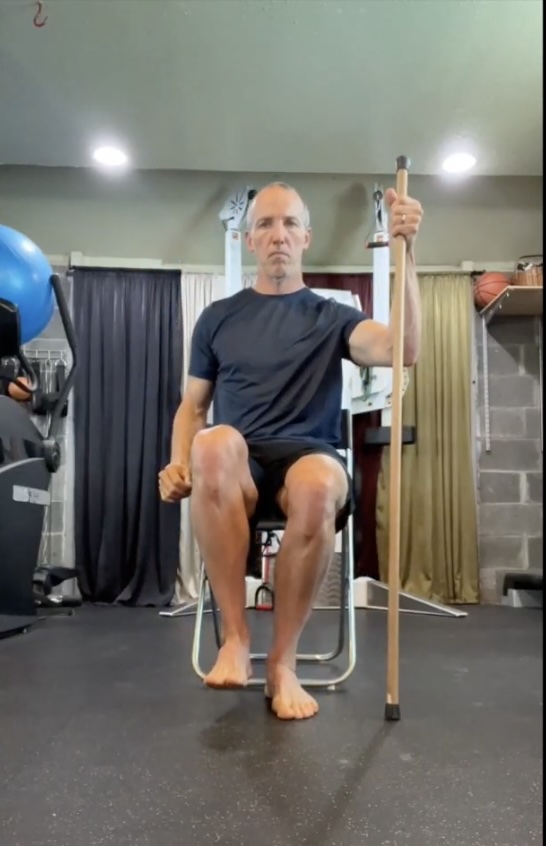
Once you’ve done both sides and have your video, watch this video to see how to interpret it.
Putting it together
What I call Functional Linking is how I think about these patterns clinically: a problem in one part of the body, left uncorrected, can work its way through the musculoskeletal system and eventually show up somewhere else entirely. A tight calf on one side can flatten that foot, contributing to a Sidebending Problem, which irritates the sciatic nerve, eventually contributing to leg or foot sciatic nerve pain. It can take months, or even decades, to wind through the body this way, and by the time it does, an MRI will often show a structural finding, a disc bulge, a torn meniscus, arthritis, that looks like the whole explanation but is really the final link in a longer chain of events.
Some links in this article are affiliate links. If you buy through them I may earn a small commission, at no extra cost to you. I only recommend products I actually use with patients.
This is exactly what Ruth was dealing with when she wrote to me about chronic pain from both replaced knees, low back pain, and neuropathy. Rehab after a joint replacement addresses the length and strength of that knee joint, but it typically doesn’t address the biomechanics that led to the breakdown in the first place, or the compensation pattern that’s already been loading the other side. Maybe you found this happening with you after trying the compensation test above.
If one knee is breaking down and you subconsciously start favoring it, the other knee, hip, back or foot starts absorbing more, and eventually you’re left dealing with other pain instead of addressing the pattern that caused the first one. It’s backed by research too: people with one-sided hip osteoarthritis are more likely to eventually need their opposite knee replaced than the knee on the same side as the affected hip, tied to measurably higher loading on that knee even before surgery happens.4
Denise’s case shows how this works in reverse: fix the pattern feeding the system, and joints you never specifically treated can improve, because they were never really separate problems to begin with. Her knee pain was never actually about her knee.
That’s the point of this and my other articles. The knee sits in the middle of a chain that runs from your foot to your back, which means knee pain is rarely only about the knee, or the only problem you’ll find if you look. And while it’s a common refrain that it’s all connected, there’s precious little information about exactly how those connections work. That’s what my last 30 years as a PT has been focused on mapping out.
If you came here for knee pain specifically, it’s important to understand whether you’ve also got hip, back, or foot issues you’ve been treating, or ignoring, as unrelated. In my clinical experience, they usually aren’t.
Next in this series: the tiny muscle behind stubborn knee pain, which is often what’s left when the hip and foot factors have already been addressed.
Rick’s takeaway
The knee has the least room of any joint in the leg to absorb rotation it wasn’t given. So when a knee keeps hurting, the useful question usually isn’t what’s torn inside it. It’s what’s sending extra rotation into it from the hip above or the foot below, and which leg has been quietly carrying the load.
Common questions
Can knee injections or a knee replacement still help if the real problem is upstream?
Yes, injections can reduce pain, but they don’t necessarily change the movement patterns contributing to ongoing stress on the joint. A knee replacement addresses the damaged joint itself, but it doesn’t necessarily change movement patterns elsewhere in the body, which is why it can still be useful to look at hip, foot, and whole-body mechanics during rehabilitation. Think of those treatments as an opportunity to fix the up- or downstream issues with less pain in the way. I go further into the surgery-versus-conservative-care decision in my arthroscopic surgery article.
How do I know if my knee pain is coming from my hip, my foot, or my knee itself?
No single answer is right for everyone. Testing is what separates the possibilities: how well your glutes fire, the shape of your thigh bone, whether your foot pronates, whether your calf and soleus are tight, and which leg the compensation test reveals as the real problem all give you different pieces of the picture. My knee pain home program helps you figure all that out.
Can hip problems cause knee pain?
Yes. The hip controls how the thigh bone rotates as you walk, and poor hip and glute control is one of the most common upstream drivers of knee pain I see, whether or not the hip itself hurts.
Can foot problems cause knee pain?
Yes. An overpronated foot can rotate the lower leg bone in a way that adds stress to the knee above it, and tight calf and soleus muscles can do the same by restricting how your ankle moves.
The compensation test showed my pain is on my stronger leg. Doesn’t that mean my other leg is fine?
Not necessarily, and this is the counterintuitive part. If your pain is on the leg your brain treats as stronger, it’s often because that leg is compensating for an older, sometimes much older, problem on the other side. The weaker leg is frequently the one that needs attention, even though it isn’t the one hurting right now.
I have hypermobile joints. Does that change any of this?
It can be a contributing factor. Hypermobility means the ligaments stabilizing a joint are looser than typical, which places more of the stabilization job on muscles and how well you’re using your body, making the hip, foot, and calf factors in this article even more relevant, not less.
My doctor says my knee pain is just wear and tear from age. Is that the whole story?
Age gives the wrong movement patterns more time to compound, but age by itself doesn’t explain why one knee wears down and not the other, or why pain keeps returning after treatment. The mechanical stresses discussed in this article are often the more useful place to look.
Does this mean I don’t need to strengthen my quad?
Not necessarily. Poor quad strength is often blamed for knee pain, but usually there are other missing pieces for pain that keeps returning. Most people who’ve tried physical therapy have already worked on quad strength; what’s often missing is testing what’s happening above and below the knee.
If the hip, the foot, or the compensation test rang true
Work the whole chain, not just the knee
7 Days to Better Knees is built specifically around everything in this article: the hip, the foot, and the compensation pattern behind so much recurring knee pain.
Explore 7 Days to Better Knees
Want the whole framework? Pain Patterns covers functional linking, the compensation test, and the rest of this systems-thinking approach in full detail.
Have a question this article didn’t answer?
Send it through the Ask Rick form. I read every question and use the most common ones to shape future articles, videos, and my monthly email — sometimes by featuring them, never with identifying details, in a public answer. I ask for your email in case I need more detail, or want to let you know when I’ve covered it.
References
- Deasy M, Leahy E, Semciw AI. “Hip Strength Deficits in People With Symptomatic Knee Osteoarthritis: A Systematic Review With Meta-analysis.” Journal of Orthopaedic & Sports Physical Therapy. 2016;46(8):629–639. Found hip strength deficits are well documented in people with symptomatic knee osteoarthritis compared to healthy controls. ↩
- Barton CJ, Levinger P, Webster KE, Menz HB. “Kinematics Associated with Foot Pronation in Individuals with Patellofemoral Pain Syndrome: A Case-Control Study.” Journal of Foot and Ankle Research. 2011;4(Suppl 1):O4. Found earlier rearfoot eversion timing in people with patellofemoral pain but no significant difference in tibial rotation compared to controls, illustrating that the foot-pronation-to-knee-pain link is real but not fully consistent across studies. ↩
- Macrum E, Bell DR, Boling M, Lewek M, Padua D. “Effect of Limiting Ankle-Dorsiflexion Range of Motion on Lower Extremity Kinematics and Muscle-Activation Patterns During a Squat.” Journal of Sport Rehabilitation. 2012;21(2):144–150. Restricting ankle dorsiflexion during a squat produced increased knee valgus, decreased quadriceps activation, and increased soleus activation, changes similar to those seen in patellofemoral pain. ↩
- Shakoor N, Block JA, Shott S, Case JP. “Asymmetric Knee Loading in Advanced Unilateral Hip Osteoarthritis.” Arthritis & Rheumatism. 2003;48(6):1556–1561. Found that people with unilateral hip osteoarthritis are preferentially predisposed to develop progressive osteoarthritis in the contralateral (opposite) knee rather than the knee on the same side as the affected hip. ↩