Knees
The tiny muscle behind stubborn knee pain
It’s small, deep, and easy to overlook on standard imaging — and in my clinical experience it’s one possible reason knee pain doesn’t fully go away.
Licensed orthopedic physical therapist with 30 years of clinical experience, former owner of an
orthopedic PT clinic, and author of the Fixing You book series, including
Fixing You: Hip & Knee Pain and the award-winning Pain Patterns
(2025 NIEA Award winner). He created an APTA-approved continuing education course teaching other
clinicians his systems-thinking approach to chronic pain.
Most knee pain content talks about the meniscus, the ACL, the PCL. There’s a small muscle behind your knee that gets a paragraph in most textbooks, and a protective spasm in it isn’t necessarily obvious on routine imaging.
The small muscle that’s easy to miss
If you’ve had knee pain that hangs on after an injury, a surgery, or with no clear cause at all, and your imaging keeps coming back clean, there’s a small muscle behind your knee worth checking. It’s called the popliteus. In my clinical experience it’s one possible reason knee pain doesn’t fully go away, especially after trauma or surgery — and it’s easy to overlook.
Pain from popliteus involvement shows up as either very sharp pain or a chronic deep ache. That’s because of its outsized role in knee function, given how tiny it is.
Always follow the guidance of your medical team. What follows isn’t a diagnosis. If your knee is painful, especially after a recent injury or surgery, see a qualified professional for an evaluation.
Watch the video version
Several real cases, including two where this muscle locked a knee.
Why does my knee still hurt even though every test comes back normal?
If your imaging, ligament tests, and meniscus have all checked out fine and your knee still hurts, a small muscle called the popliteus may be the trouble.
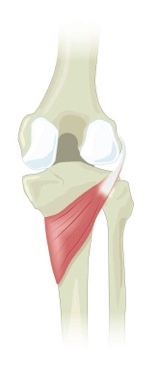
The popliteus sits deep behind your knee. Anatomically, it’s known as the muscle that “unlocks” a fully straight knee so bending can begin. It also helps control rotation between your thigh bone and shin bone, and protects your outer meniscus from getting pinched during movement.1
That rotational role connects directly to the femoral condyle mechanics I explained in the first article in this series: the same small, built-in rotation that makes the knee vulnerable to stress from the hip and foot above and below is also exactly what the popliteus helps manage. After trauma to the knee — surgery, a fall, a twist, or a strain — this muscle can get stuck in a protective spasm. In my clinical experience, that spasm alone is enough to keep pain lingering long after the original injury has healed, and occasionally enough to keep a knee from fully straightening.
What is the popliteus, and why does everyone miss it?
Quick take: The popliteus is small, deep, easy to overlook on routine imaging, and barely covered in most clinical training — which is exactly why it gets missed so often.
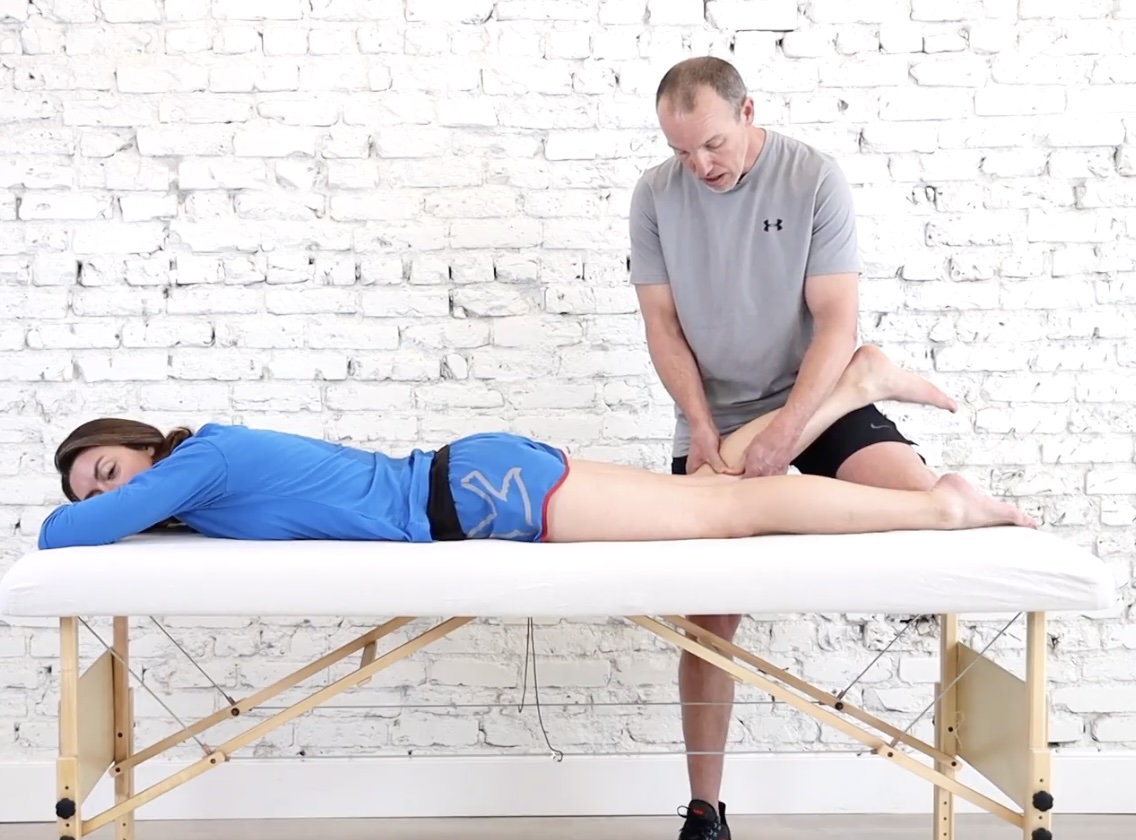
The popliteus runs from the outer condyle of the thigh bone to the inner portion of the tibia. Most of the muscle bulk is in that inner tibial area to the mid knee, and that’s where I focus when massaging this little guy.
Because it crosses the knee joint and runs from inner to outer portions of the knee, it’s involved with knee joint rotation — which, if you read the first article, is built into the knee joint structure by virtue of the asymmetrical shapes of the femoral condyles interacting with the tibia. The popliteus is the only muscle in the knee that starts and ends in the knee. It’s pretty important.
Given that, you’d think more attention would be given to it in medical training. My own education, and it seems the training of the other PTs I’ve trained in my clinic, hardly even mentioned this small titan.
A few reasons this muscle slips past even thorough evaluations:
- It’s tiny and deep. Hard to palpate accurately even if you know exactly where to look.
- A protective spasm isn’t necessarily obvious on routine imaging. MRIs are excellent at catching torn structures. A muscle in spasm doesn’t show up the same way.
- Training focuses on the bigger players. ACL, PCL, and meniscus get extensive coverage. The popliteus often gets a paragraph.
- The symptoms mimic something else. An ache deep behind the knee, or a knee that doesn’t feel quite right, looks a lot like meniscal, cartilage, or ligament damage — so that’s what gets treated, sometimes repeatedly.
It’s a recognized issue in the orthopedic literature too. Popliteal tendon impingement is described as an under-recognized cause of persistent pain following total knee replacement specifically, sometimes requiring its own targeted treatment separate from the joint replacement itself.2
Signs it might be your popliteus
I’m not aware of a specific popliteus test that’s reliable. Instead I just press on it gently. If someone winces at my light touch, I suspect the popliteus is in spasm.
Worth considering if
Four signs to look for
- You have a persistent knee ache or pain that hasn’t fully resolved.
- Standard imaging and exams come back essentially normal.
- You’ve had knee surgery, a fall, or a twisting injury — even a while ago.
- Your knee occasionally feels stiff, catches, or doesn’t move quite the way it should.
Now that you’re aware of this ornery little muscle, mention it at your next appointment and have your PT or massage therapist check it out.
I’m not saying the popliteus is always the answer. But in my experience it’s missed quite a bit, especially in people who’ve been told repeatedly that nothing shows up on their scans. When it really is the source, releasing the spasm can produce a surprisingly rapid change in pain and range of motion.
Real cases
A woman days out from a tibial plateau fracture. Significant pain, limping into my clinic. Releasing her popliteus reduced her pain by roughly 90%. She walked out without a limp.
A patient recovering from major knee reconstruction. Significant pain at his first visit after surgery. One session of popliteus release gained him about 15 degrees of knee extension. Nothing else changed that visit.
— Rick’s case notes
Those two show the ordinary version of what this muscle does: persistent pain that responds fast once it’s actually addressed. Then there are the two cases that show how far this can go.
Jeni, 9 years old. She fell hard in gym class and bruised the bone where her thigh bone meets her shin. Nothing broke. But a month later her knee was still locked at a bent angle, and she’d started compensating — walking on her toes on that side, hiking her hip up with every step to take weight off the joint. Her hamstrings and calf muscles, the usual suspects for a knee that won’t straighten, were normal. My clinical assessment: her popliteus had gone into protective spasm from the trauma, and the spasm itself was compressing the joint further, irritating the bruise more, triggering more spasm. A closed loop. I located her popliteus, applied a pound or two of pressure with a slight rotation to unwind the knee, and it straightened on the table in under a minute.
A man who flew from New York to Denver. Routine meniscus surgery on a man in his 60s. Instead of a few weeks of recovery, his knee never fully straightened again. Years of imaging, physical therapy, chiropractic, acupuncture, and massage all came back the same way: nothing medically wrong. Everyone was stumped. I checked his popliteus, released it in about five minutes of massage, and his knee straightened on the table. You should’ve seen his face.
— Rick’s case notes
Locked knees like these are dramatic, but they’re the extreme end of this muscle’s role in knee pain. Consider that after standard knee surgery, one of the most important goals is regaining full knee extension. That alone shows how much this small muscle can matter, and how much pain and frustration could be saved simply by checking it.
I’ve encountered it in dozens of cases that had stumped other practitioners: in athletes with a lot of lower-body rotation, in people with arthritis where the muscle stays in protective mode long after protection is actually needed, and consistently after any kind of direct trauma to the knee.
Putting it together
After knee injury or surgery, research shows the nervous system can reflexively reduce activation in surrounding muscles — a phenomenon called arthrogenic muscle inhibition, well documented in the quadriceps as a cause of persistent weakness and extension deficits after ACL surgery and knee replacement.3 In my clinical experience, the popliteus can behave differently: instead of becoming inhibited, it appears to remain in sustained protective spasm, actively guarding the joint rather than going quiet.
This ties into the same idea I cover throughout this series: the body doesn’t always let go of a protective pattern just because the original threat is gone. Jeni’s knee wasn’t broken by the time I saw her. It was guarding against a threat that had already passed. Most people reading this don’t have a locked knee — they have pain or stiffness that never quite resolved. In my experience, a less dramatic version of this same protective pattern can sometimes be involved.
Of course, massaging the popliteus isn’t the whole answer to your knee pain. Once you’ve released it, you still need to address the systemic problems causing it to be irritated in the first place.
Rick’s takeaway
“Nothing showed up on the scan” isn’t the same as “nothing is wrong.” A muscle stuck in protective spasm doesn’t image like a tear — and in the knee, the one most likely to be doing it is the one almost nobody checks.
Common questions
Can I release my own popliteus at home?
It’s possible, but typically I have to show people where it is. I demonstrate my specific technique in my home program, but if you’re not confident locating it, a qualified practitioner can help. Once they’ve located and massaged it, they can show you how to do it yourself — though I’ve found it most effective when someone else does it for you.
Is popliteus involvement dangerous, or does it mean something is seriously wrong?
Not necessarily. Most of the time it’s a protective muscular response, not structural damage. But popliteus-region pain can also come from actual tendon injury, so persistent pain after an injury or surgery still deserves a proper evaluation rather than assuming it’s simply a spasm.
Can the popliteus cause pain behind the knee specifically?
Yes. Because it sits deep in the back of the knee, popliteus involvement often shows up as an ache or pain right behind the joint — sometimes mistaken for a hamstring or calf issue, since both cross that same area.
How is this different from just stretching my calf or hamstrings?
Those are different muscles crossing the knee, and they’re worth checking too, but they’re not the same as the popliteus, which is directly involved with the knee’s built-in rotation. In several of my cases, hamstrings and calf tested completely normal while the popliteus was the actual issue.
Does research support the popliteus being missed after knee surgery?
Yes. Popliteal tendon impingement is documented in the orthopedic literature as an under-recognized cause of persistent pain specifically after total knee replacement.2 I believe the same pattern — a protective muscular response rather than a structural tendon problem — shows up even more often than the surgical literature captures, since most cases never get identified as popliteus-related at all.
My knee pain came on gradually, with no clear injury. Could this still apply?
Possibly. Chronic flat feet (covered in my foot and ankle article), hip problems, and repetitive lower-body rotation in sports — including the kind that femoral anteversion or retroversion can create (covered in my hip pain series) — can all keep this muscle chronically activated even without one specific traumatic event, since each feeds into the same knee-rotation problem.
Does this always cause a locked knee, like Jeni’s case?
No, that’s actually rare. Far more often it shows up as an ordinary, persistent ache, pain, or stiffness that doesn’t fully go away. The locked-knee cases are the most dramatic illustration of how much influence this muscle has, not the typical presentation.
Can a popliteus problem cause a knee that won’t fully straighten?
Yes, though it’s the extreme end of what this muscle does. Jeni’s case and the New York patient’s case both involved a knee locked in a bent position, resolved once the popliteus released.
Can the popliteus cause knee pain after surgery?
Yes. It’s a recognized issue in the orthopedic literature specifically after total knee replacement, and in my clinical experience it also shows up after other knee surgeries, falls, or strains — whenever the joint has been through trauma significant enough to trigger a protective response.
Once the popliteus is released
Address what irritated it in the first place
7 Days to Better Knees includes the popliteus release technique, along with the testing and systems-based exercises I use to identify and address the factors that keep knee pain going.
Explore 7 Days to Better Knees
Want the whole framework? Pain Patterns covers the rest of this systems-thinking approach in full detail.
Have a question this article didn’t answer?
Send it through the Ask Rick form. I read every question and use the most common ones to shape future articles, videos, and my monthly email — sometimes by featuring them, never with identifying details, in a public answer. I ask for your email in case I need more detail, or want to let you know when I’ve covered it.
References
- Olewnik Ł, Landfald IC, Gonera B, Triantafyllou G, Domosławska D, Piagkou M, LaPrade RF. “Popliteus Tendon Morphology: Anatomical Classification and Clinical Implications: A Narrative Review.” Biomedicines. 2025;13(9):2053. Describes the popliteus as initiating flexion of the fully extended knee, contributing to rotational stability, and helping protect the lateral meniscus from entrapment during movement. ↩
- Finsterwald MA, Lu V, Andronic O, Prosser GH, Yates PJ, Jones CW. “Popliteal Tendon Impingement as a Cause of Pain Following Total Knee Arthroplasty: A Systematic Review.” Arthroplasty. 2023;5(1):45. Describes popliteal tendon impingement as an under-recognized cause of persistent pain following total knee replacement, often requiring dedicated diagnosis and treatment separate from the joint replacement itself. ↩ ↩
- Sonnery-Cottet B, Hopper GP, Gousopoulos L, Vieira TD, Thaunat M, Fayard JM, et al. “Arthrogenic Muscle Inhibition Following Knee Injury or Surgery: Pathophysiology, Classification, and Treatment.” Video Journal of Sports Medicine. 2022;2(3):26350254221086295. Describes arthrogenic muscle inhibition, a reflexive reduction in muscle activation after knee injury or surgery, well documented in the quadriceps. Cited here for contrast: the popliteus’s response — sustained spasm rather than inhibition — is a distinct clinical observation, not something this study measures. ↩