Conditions & surgery · should I…?
Meniscus, rotator cuff, or labrum surgery? What the research actually says
A physical therapist’s honest look at arthroscopic surgery versus physical therapy for the knee and shoulder — and how to get a real answer instead of a guess.
Licensed orthopedic physical therapist, 30 years of clinical experience. Former clinic owner and
author of Pain Patterns, winner of the 2025 NIEA Award, and creator of a systems-based
approach to chronic pain used in his APTA-approved continuing education course.
Millions of people get this surgery every year. A camera and some tiny tools go into your knee or your shoulder, a surgeon cleans up whatever looks torn or damaged, and you’re told you’ll be back to normal in a few weeks.
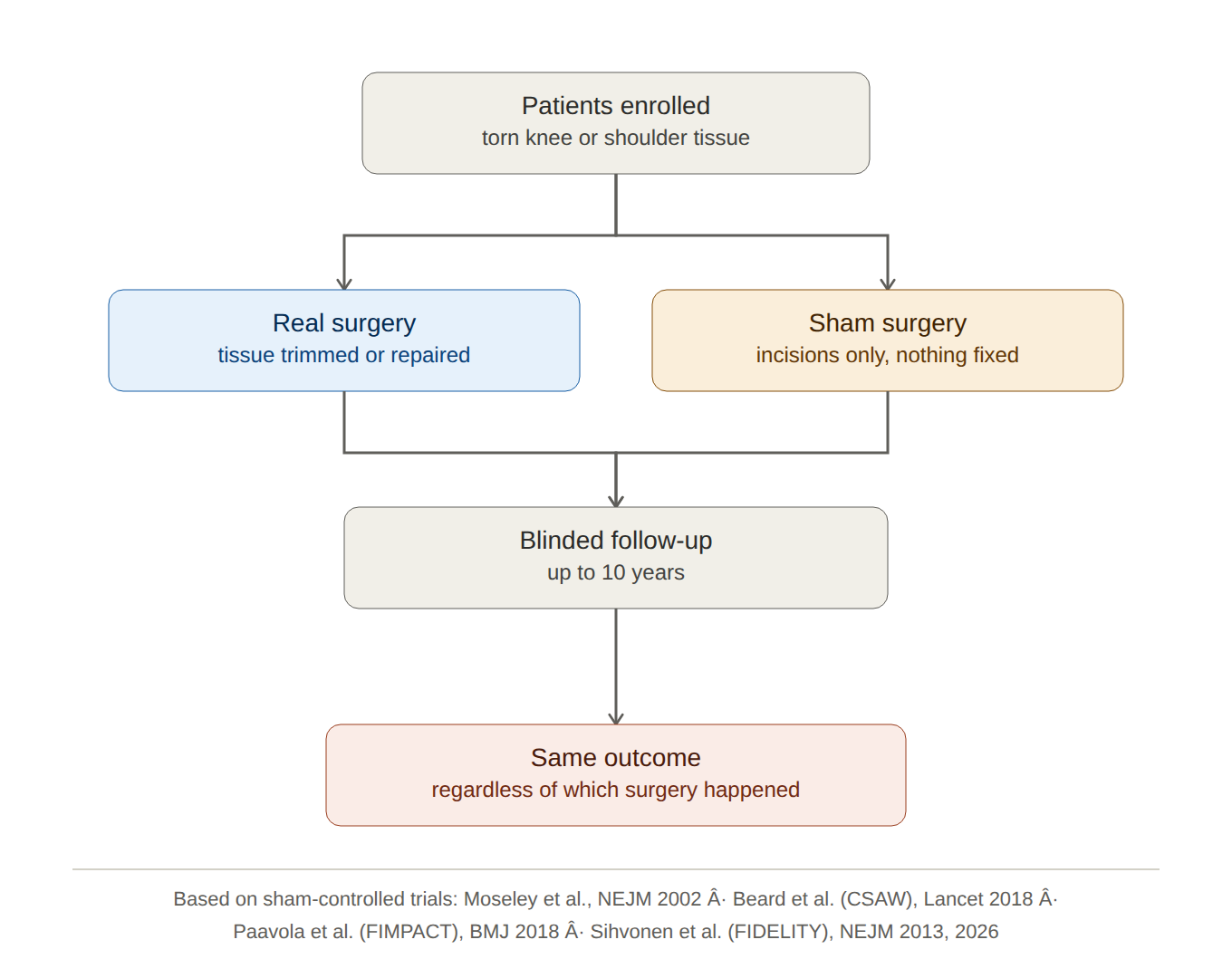
What most people never hear before they agree to it is that some of the best studies we have randomly assigned half the patients to real surgery and half to a fake one — and nobody could tell the difference in how people recovered.1
This article is about how to think through a decision, not a recommendation for or against surgery in your case. Only you and your surgeon can make that call, with your imaging, your history, and your goals in front of you.
The short answer, based on the research
Degenerative tears — the slow, wear-and-tear kind. Multiple studies, including some where half the patients got fake surgery, found no real difference between surgery and not having it. That’s true for the knee1 and for the shoulder2 separately.
Traumatic tears — a specific fall, twist, or injury. Surgery has a stronger case, but even here, one major trial found physical therapy worked just as well for most people. About 6 in 10 never ended up needing surgery at all.3
Either way, conservative care performed about as well as surgery in the research. So the real question isn’t “surgery or nothing.” It’s whether the conservative care you tried was actually any good.
Was your conservative care actually meaningful?
Not all conservative care is created equal. Most people who end up in a surgeon’s office already tried physical therapy, and when it didn’t work, it was easy to conclude conservative care just wasn’t the answer.
I disagree. Not with the research. Not with physical therapists. But with the standard of care they’re trained to follow. It’s incomplete, which means your conservative care was probably incomplete too — and maybe why you were disappointed with the process.
I told a patient this just the other day. She’d had a knee replacement and was still seeing a PT for post-surgical rehab, but was unhappy with it, especially compared to working with me on a different problem. I explained to her that it’s not that her therapist was bad — they treated the joint exactly to the standard of care they were trained to follow. The problem is that the standard doesn’t include whether the knee actually functions well.
— Rick’s case notes
What the standard of care actually says
See for yourself. These are the real, stated goals of physical therapy, straight from the American Physical Therapy Association,45 cross-checked against Mayo Clinic and OrthoInfo.6 Same standard, everywhere you look.
Shoulder
- Reduce pain
- Restore range of motion
- Strengthen the muscles supporting the joint
- Maintain flexibility to prevent re-injury
Knee
- Reduce pain
- Restore or maintain range of motion
- Strengthen the muscles around the joint, mainly the quadriceps
- Return to daily activities
These are reasonable goals. They’re measurable, which matters — so the PT knows improvement is happening, and for insurance reimbursement. No argument there. But look at what’s missing:
- The hip, the ankle, the shoulder blade, the mid-back
- How the joint works when you walk, bend, climb stairs, reach into a cabinet
- Getting up from a chair, vacuuming, getting out of the car
That’s the gap. I understand that many of these things are also included in many PTs’ care, but that leaves it up to the therapist to decide — which, in my mind, introduces doubt that everything that should be done, was done. My patient wasn’t unhappy with bad care. She was unhappy with the standard of care, followed correctly.
A second question: who actually delivered your care?
Physical therapists are doctorate-trained. Physical therapist assistants have an associate’s degree and work under a PT’s supervision. In busy clinics, you might see the PT once, for the evaluation, and an assistant for nearly every visit after that. Clinics with heavier assistant involvement see more total visits and worse functional outcomes at discharge.9
I tried this model myself, in my own clinic. Scaling with PTAs made financial sense — I’d even considered aides too, since they’re cheaper still — but I was never satisfied with the level of care being delivered, and that might say more about my hiring than about their ability to do the job well. Either way, I couldn’t make the model work financially while holding the standard I wanted, and it’s one of the biggest reasons I ultimately sold my clinic.
Component thinking versus systems thinking
I think of the standard above as component thinking: treat the joint in front of you, get the knee or shoulder to bend and straighten well, and make sure there’s decent strength.
Instead, I use systems thinking, which incorporates how each joint affects the ones above and below it.
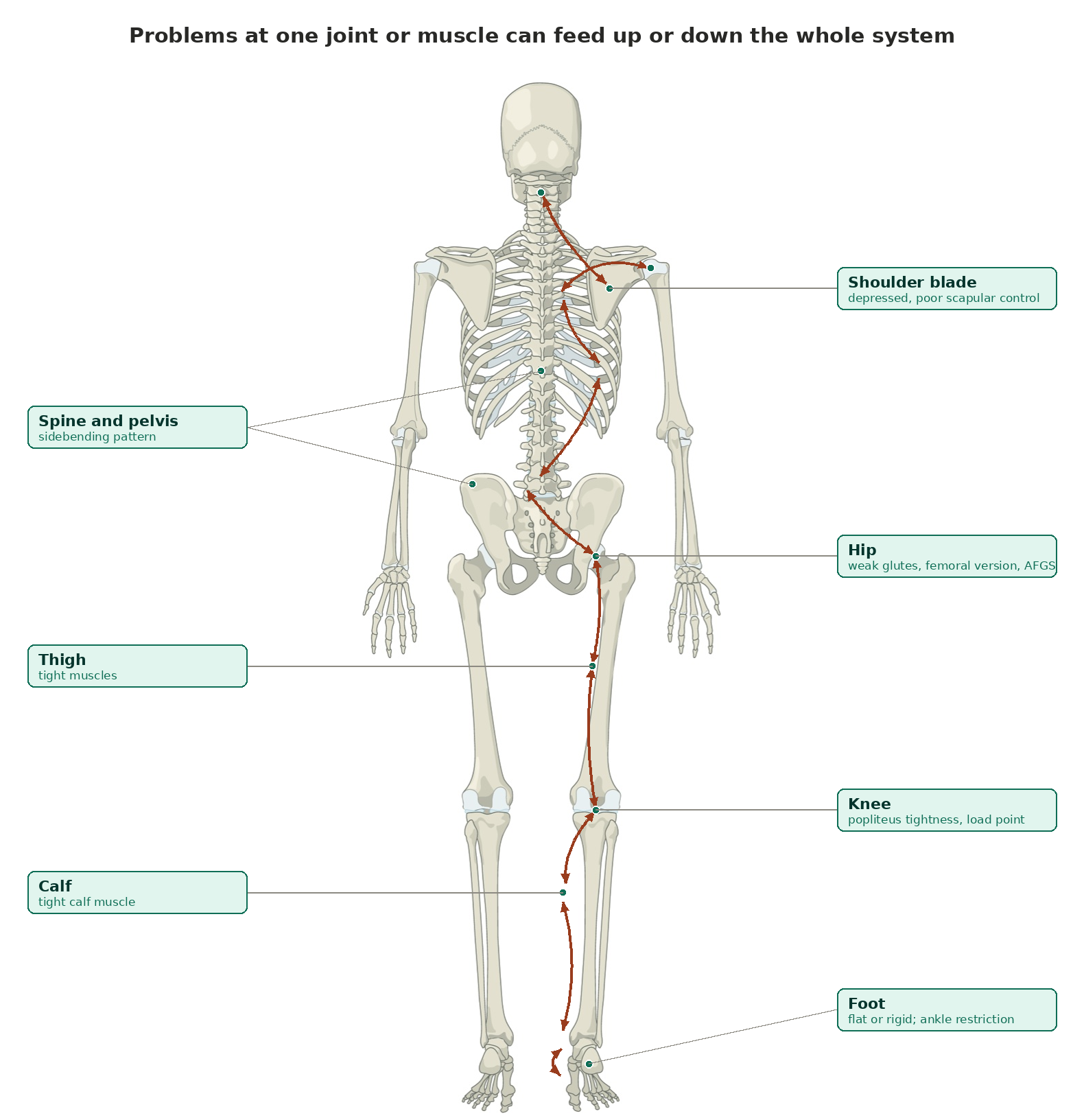
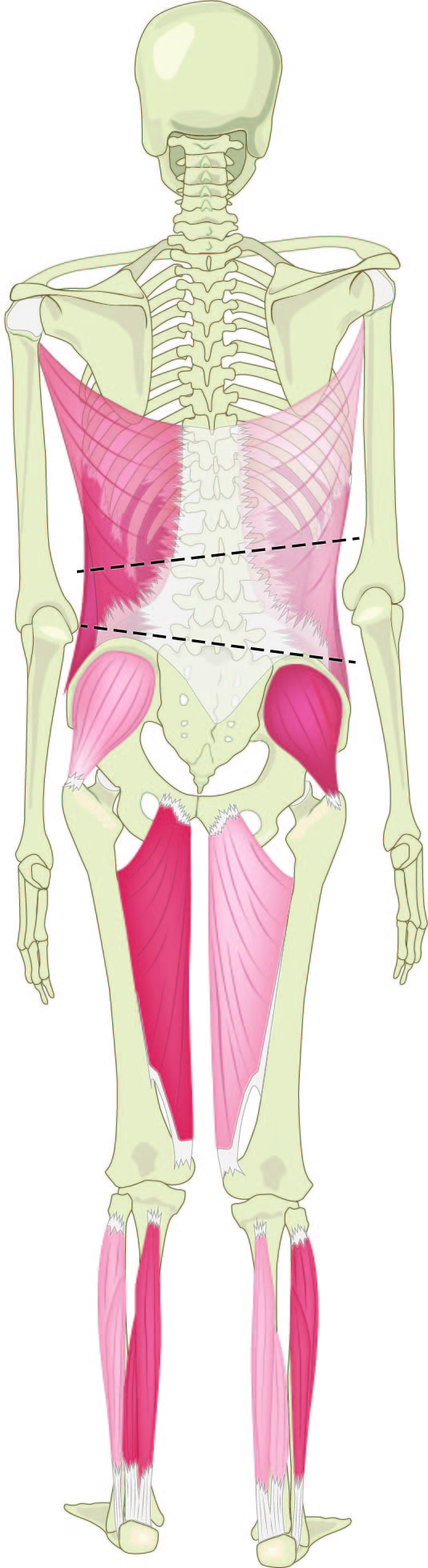
Schools don’t teach this in a meaningful way, and there’s a reason why. Medicine requires that our treatments be based on evidence, and medical research proves or disproves an effect by isolating one variable. So it’s great at “does strengthening this muscle help this joint.” It’s not very good at looking at how ten things, happening at once, across the body, add up to someone’s actual pain.
Our bodies work as systems. Research mostly doesn’t. So systems thinking never made it into the curriculum — not because it’s wrong, but because this type of research is difficult to generate by its very nature.
That’s why the surgery-versus-conservative-care trials cited earlier make me wince a little. I don’t actually know the exact conservative care protocol each of those trials used.* It’s reasonable to assume it followed something close to the standard of care listed above. If so, I don’t think it went far enough to give conservative care a fair shot. My honest belief — not provable, just decades of clinical experience talking — is that a systems-thinking approach would have tipped those results further toward conservative care, not surgery.
I’m not criticizing other PTs
Some PTs will bristle reading this. I get it, but I’m not critiquing PTs.
PT school is brutally competitive. Nearly every PT I’ve met is sharper than I am. This was never about intelligence. It’s about training. Every PT I know could do what I do, probably better, if anyone had shown them how. I’ve seen it firsthand, training my own PTs at my orthopedic clinic for years.
I built this systems understanding myself, over three decades, the slow way that happens when you’re chasing a feeling that something wasn’t adding up. Recently I built a 30-credit CEU program so other PTs don’t have to spend three decades doing the same — and more importantly, so their patients don’t spend years cycling through care that was never built to ask what their body actually needed.
What I actually check before recommending knee or shoulder surgery
Knee
- Gait: how you actually walk.
- Hip and glute firing pattern: weak or poorly-timed glutes overload the knee7 (learn here, or watch the test).
- Foot and ankle mechanics: changes how force travels up before it hits the knee.
- Femoral version: thigh bone angle in the hip socket (test it yourself).
- Popliteus tightness: a small, forgotten muscle behind the knee that’s a commonly overlooked source of ongoing knee pain (learn here).
- Pelvis and rib cage level: uneven often means one leg isn’t working right (see it here, or watch it).
- Compensation: is the painful knee the problem, or is the other leg forcing it to overload? (test for it here).
- Standing habits: equal weight on both legs? Does one knee lock more?
- Anterior femoral glide: does the thigh bone move correctly in the socket? True AFGS testing needs a practitioner, but weak glute function is usually the giveaway that it’s likely present.
Shoulder
- Shoulder blade position and mechanics:8 there are rules about how the shoulder blade rests and moves (see the landmarks).
- Serratus anterior function: a key muscle moving and stabilizing the shoulder blade; when it’s not doing its job, the whole shoulder mechanism suffers.
- Sidebending pattern: the rib cage matters because the scapula rests on it (learn about it in my sciatica article, where I cover the full test and fix, or watch it here).
- Trapezius function: precise, or just present?
This isn’t exotic, and it isn’t alternative medicine. It’s the same logic doctors use everywhere else: don’t just treat where it hurts, ask what’s driving it.
If you’ve decided to move forward with surgery
Everything above is about coming to the decision itself. If you’ve already made it, this next part is about doing it well — and that starts with your pre-op consultation. These aren’t questions about whether to have surgery. That’s settled. They’re about making sure the specific surgery you’re about to have, and the surgeon doing it, are set up to meet your goals.
Five things to ask before you go in
Take these to your pre-op consultation
- Check the research yourself. Go to pubmed.ncbi.nlm.nih.gov and search your procedure plus “outcomes.” Look for randomized trials and systematic reviews near the top. Ten minutes, and you’ll walk into your consultation more informed than most patients.
- Know whether you’re degenerative or traumatic, and what that changes. Ask your surgeon directly which one they think you are. The evidence for surgery is weakest for degenerative tears, and stronger — though still not automatic — for traumatic ones.
- Ask whether they’re repairing or removing the tissue. Repair holds up better long term, sometimes dramatically so. One systematic review found arthritis progression in 51% of patients after tissue removal, versus 21% after repair.10 If removal is the plan, ask why repair isn’t possible.
- Ask for specifics. What percentage of patients still have pain after two years? What percentage eventually need a joint replacement?
- Ask what “successful” actually means to them. Function, pain relief, or both? These are different promises. A surgeon can speak with real confidence about what exactly their procedure will do. Pain is a different question entirely, and no one can anticipate your body’s reaction to the surgery: inflammation, pain, infection, spasm, or none of these.
What happened to me
A few years ago I was trail running, fell, and tore my shoulder labrum — a SLAP tear. I did the work: months of rehab, movement patterns identified and addressed, before I ever considered surgery. This was a real, traumatic injury, not something obvious that went unaddressed.
I had the surgery anyway. My rehab went well, ahead of schedule on every metric my surgeon tracked. And I have more pain now than I did before it.
— Rick Olderman
It just goes to show that you can do everything right and still have pain. But knowing I did everything right beforehand gives me peace of mind: this is simply the best outcome available to me. That matters. I can compartmentalize it.
It also exposed something in my own thinking. When I got that diagnosis, repairing the tear wasn’t really a decision I weighed. It just felt like what you do. If a PT who’s spent three decades studying this didn’t know the research on arthroscopy’s risks going in, most people don’t either. That’s the reason this article, and the two YouTube videos I made about this, exist.
How to improve your outcome
The difference between component thinking and systems thinking doesn’t disappear just because you’re now post-surgical. If you’ve decided to move forward, here’s my advice: get together with your physical therapist beforehand and address every weakness and tightness issue affecting your function, as thoroughly as you can. Maybe even try the tests above to measure your function more broadly.
This serves two purposes. After surgery, muscles that were cut seem to temporarily lose their connection to the brain, and activating them again becomes harder. If you’ve already practiced activating those muscles beforehand, that connection tends to come back faster afterward, which speeds up your recovery.
Second, the more you fix your function before surgery, the clearer a baseline you have. That makes it much easier to tell, afterward, whether your function actually improved, instead of guessing.
Where this leaves you
If your situation is degenerative, the honest takeaway is that surgery probably isn’t your best first move, and a real trial of meaningful conservative care is worth doing first. If it’s a genuine traumatic injury with a mechanical block, or repair is possible and conservative care has genuinely been tried, surgery becomes a far more reasonable option.
Rick’s takeaway
The tear on your scan is very often a symptom of something else happening in how your body moves, not the whole cause. If that something else doesn’t get addressed, it won’t matter whether surgery happens or not — the pain can come right back, or never fully leave in the first place.
Common questions
Is arthroscopic surgery better than physical therapy?
For degenerative tears, the research says no, not reliably. Multiple studies, including sham-controlled ones, found no meaningful difference between surgery and conservative care. For traumatic tears, surgery has a stronger case, but even then, most people in one major trial did fine with physical therapy alone.
Can a meniscus tear heal without surgery?
The tear itself usually doesn’t “heal” in the sense of disappearing on a scan. But the pain and function connected to it often improve significantly with the right conservative care, especially for degenerative tears. Whether surgery adds anything on top of that depends on whether the tear is degenerative or traumatic, and whether it’s mechanically blocking the joint.
When is arthroscopic knee surgery actually necessary?
The clearest case is a mechanically locked joint — one that physically can’t move because a torn piece is in the way. Traumatic tears in younger, active patients, especially when repair is possible, are the next strongest case. Degenerative tears are the weakest case for surgery as a first move.
Is a degenerative meniscus tear different from a traumatic one?
Yes, and it changes the odds. A degenerative tear builds up gradually, usually with age, and has no single triggering event. A traumatic tear comes from a specific fall, twist, or impact. The research against surgery is strongest for degenerative tears.
What should I ask my surgeon before agreeing to arthroscopy?
At minimum: whether your tear is degenerative or traumatic, whether they’re planning to repair or remove the tissue, the real risks including long-term joint health, and what they actually mean by a “successful” outcome — function, pain relief, or both. The full list is above.
Can physical therapy prevent the need for arthroscopic surgery?
For a meaningful share of people with degenerative tears, yes, based on the research cited throughout this article. It’s not guaranteed for everyone, but it’s underused as a genuine first option — partly because most conservative care never actually gets tested the way it should.
If you want to test your own function first
Two starting points, depending on where it hurts
If it’s your knee, the knee program runs you through the same testing I use in person, then builds your corrective plan from it. There’s no standalone shoulder program yet — but stubborn shoulder pain happens for the same reasons stubborn neck pain and headaches do, so the neck program is the one to start with. It’s built around shoulder blade mechanics.
7 Days to Better Knees
Shoulder pain instead? Start with 7 Days to a Better Neck — watch the walkthrough video to see if it makes sense for you.
Have a question this article didn’t answer?
Send it through the Ask Rick form. I read every question and use the most common ones to shape future articles, videos, and my monthly email — sometimes by featuring them, never with identifying details, in a public answer. I ask for your email in case I need more detail, or want to let you know when I’ve covered it.
References
- Knee — sham-controlled and standard-of-care trials showing no meaningful benefit of surgery over non-surgical care for degenerative tears: Moseley et al., N Engl J Med, 2002; Kirkley et al., N Engl J Med, 2008; Sihvonen et al. (FIDELITY), N Engl J Med, 2013, 10-year follow-up 2026. ↩ ↩
- Shoulder — sham-controlled trials showing the same pattern: Beard et al. (CSAW), The Lancet, 2018; Paavola et al. (FIMPACT), BMJ, 2018. ↩
- van der Graaff et al. (STARR trial), Br J Sports Med, 2022. Traumatic meniscal tears, ages 18–45, immediate surgery versus physical therapy with surgery available if needed. ↩
- Desmeules F, Roy JS, Lafrance S, et al. “Rotator Cuff Tendinopathy Diagnosis, Nonsurgical Medical Care, and Rehabilitation: A Clinical Practice Guideline.” J Orthop Sports Phys Ther. 2025;55(4):235–274 (American Physical Therapy Association, Academy of Orthopaedic Physical Therapy). Source for the shoulder goals list above, and for the scapular motion-tracking finding discussed later in this article. ↩
- Logerstedt DS, Scalzitti DA, Bennell KL, et al. “Knee Pain and Mobility Impairments: Meniscal and Articular Cartilage Lesions, Revision 2018.” J Orthop Sports Phys Ther. 2018;48(2):A1–A50 (APTA, Academy of Orthopaedic Physical Therapy). Source for the knee goals list above. Written for post-surgical care specifically, not as surgery’s alternative; in my clinical experience the assessment doesn’t meaningfully differ either way, but that’s my own observation, not something this citation itself supports. ↩
- Mayo Clinic Sports Medicine, “Rotator cuff injuries and surgery”; OrthoInfo (American Academy of Orthopaedic Surgeons), “Rotator Cuff and Shoulder Conditioning Program”. ↩
- Deasy M, Leahy E, Semciw AI. “Hip Strength Deficits in People With Symptomatic Knee Osteoarthritis: A Systematic Review With Meta-analysis.” J Orthop Sports Phys Ther. 2016;46(8):629–639. ↩
- Desmeules et al., 2025 (see reference 4). The scapular motion-tracking finding discussed in this article’s shoulder section comes from this same guideline. ↩
- Resnik L, Feng Z, Hart DL. “State Regulation and the Delivery of Physical Therapy Services.” Health Services Research. 2006. Compares clinics by physical therapist assistant utilization; higher assistant involvement associated with more total visits and worse patient-reported functional outcomes at discharge. ↩
- Hurmuz M, Ionac M, Hogea B, Miu CA, Tatu F. “Osteoarthritis Development Following Meniscectomy vs. Meniscal Repair for Posterior Medial Meniscus Injuries: A Systematic Review.” Medicina. 2024;60(4):569. ↩
* Trials in this space consistently describe their conservative-care arms as delivered by “the physical therapist,” never an assistant, though I can’t say that was true down to the letter for every single study cited. ↩