Feet & ankles · start here
The hidden habit behind plantar fasciitis that won’t heal
You’ve stretched. You’ve iced. Maybe you’ve tried a shoe insert. But your foot pain keeps coming back. What are you missing?
Licensed orthopedic physical therapist with 30 years of clinical experience, former owner of an
orthopedic PT clinic, and author of the Fixing You book series, including
Fixing You: Foot & Ankle Pain and the award-winning Pain Patterns
(2025 NIEA Award winner). He created an APTA-approved continuing education course teaching other
clinicians his systems-thinking approach to chronic pain.
Most plantar fasciitis advice starts and ends with “stretch your calf.” That’s not wrong, it’s just incomplete.
Why the same stretch keeps failing you
If you’ve been dealing with plantar fasciitis, heel pain, or a Morton’s neuroma-type ache in the ball of your foot, you’ve probably already been told to stretch your calf. You may have done it faithfully. And you’ve probably noticed that the first step out of bed in the morning still feels like you’re tearing tissue down there, or like there’s a pebble in your heel.
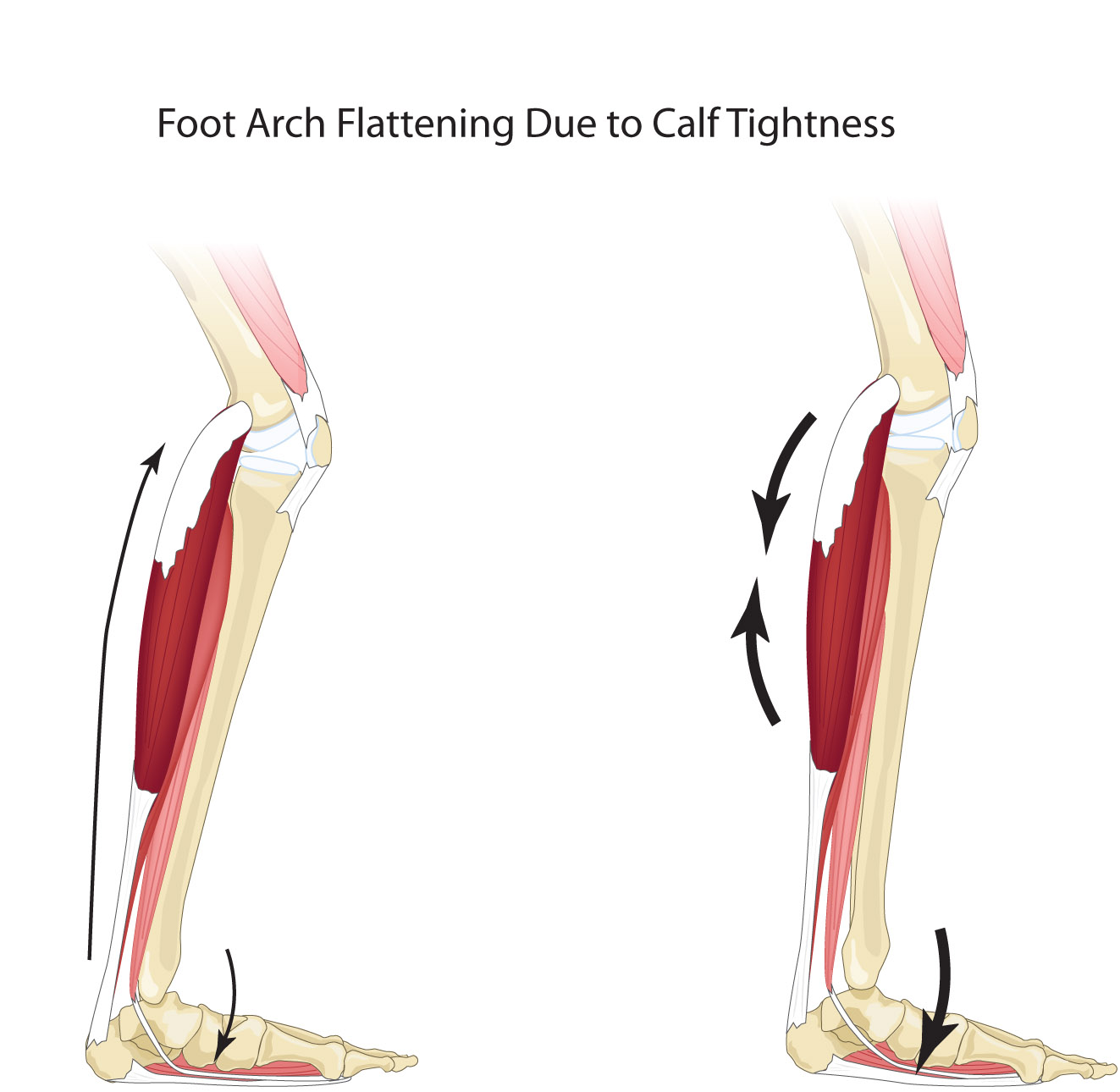
Here’s the piece that’s usually missing. When your knee can’t bend forward far enough over your foot as you walk, because your calf and soleus muscles are too tight, the forward momentum of your body has to go somewhere. It either drives up into your knee, or down into your foot, where it lands on your plantar fascia and the joints and tissues around your heel. Stretching addresses the tightness for a few minutes. It doesn’t address why the tightness keeps coming back.
Tight calves aren’t just a theory here, either: multiple studies have found gastrocnemius or gastrocnemius-soleus tightness present in a large majority of plantar fasciitis patients, far more often than in people without foot pain.1
Always follow the guidance of your medical team. What follows isn’t a diagnosis. If you haven’t had your foot and ankle evaluated — especially if pain is severe, worsening, or accompanied by numbness — get that evaluation first.
Watch the video version
The test, the overlooked habit, and the fix I use to address it.
Why won’t my plantar fasciitis heal, even though I keep stretching?
Stretching a tight calf and soleus complex helps temporarily. It turns out that something is usually re-shortening those muscles every night.
What I’ve noticed clinically is that one overlooked reason stretching alone may not hold is how people sleep. Lying on your back with the covers resting on your feet, lying on your stomach with the bed pushing your toes away from you, even most side-sleeping positions — all of them point your toes away from your body for six to eight hours a night. In my clinical experience, that’s often enough time for your calf and soleus to shorten back up, undoing whatever good you did during the day.
The first step is to see whether your calf or soleus muscles are tight in the first place.
The calf and soleus test
Quick take: Two quick positions against a wall show you whether your calf, your soleus, or both are tight, and whether one side is worse than the other.
Most research on this measures whether your ankle can reach full range of motion at all. In my clinical experience, the more common problem isn’t a hard block to motion — it’s how much effort and tension it takes to get there. Both matter, and this test picks up on both.
Try this test
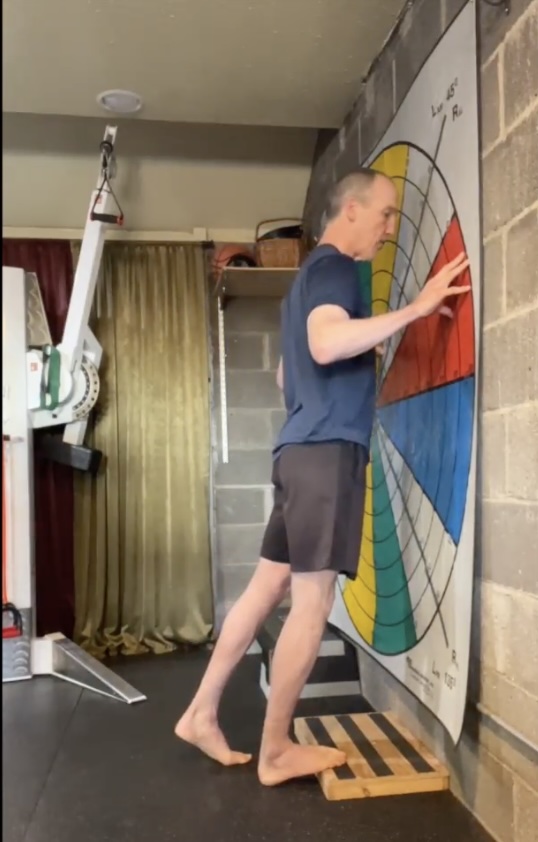
The calf test
- Place a book or block about 1 to 1.5 inches thick against a wall.
- Put the ball of one foot on the book, heel flat on the floor, facing the wall.
- Lock that knee straight.
- Lean your body forward toward the wall, hinging at the ankle, keeping your knee straight and your heel planted.
- Notice how much stretch you feel in your calf, and how far you can lean. If it feels very tight, or you’re having trouble leaning into the wall, you likely have tight calf muscles. Repeat on the other side.
Try this test
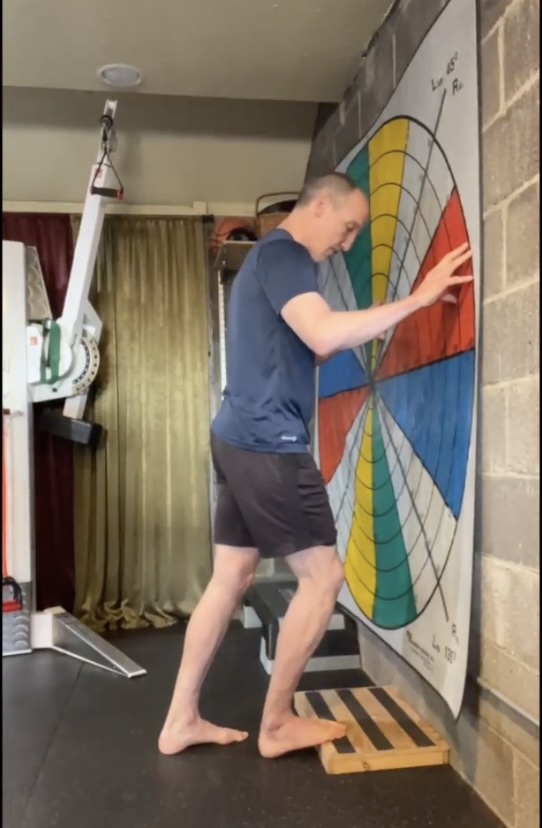
The soleus test
- Same setup: ball of your foot on the book, heel on the floor.
- This time, bend that knee forward so it travels toward your first or second toe, heel still planted.
- Notice the stretch — usually closer to your ankle this time — and how far your knee can travel. If it feels very tight, or you’re having trouble bending your knee toward your toes, you likely have tight soleus muscles. Repeat on the other side.
In my experience, the side with more pain is often also the tighter side. If both sides hurt, they’ll often feel similarly tight.
The sleeping habit undoing your progress
Quick take: However you sleep, your toes are probably pointed away from your body for most of the night, which shortens your calf and soleus right back up after any stretching you did during the day.
Think about your sleeping position. On your back with the blanket resting over your feet, the weight points your toes away from you. On your stomach, the mattress does the same thing. Even on your side, most people point their feet away from the body. All three add up to the same thing: hours of your calf and soleus sitting in a shortened position, night after night.
The fix. A dorsal night splint holds your ankle in a more neutral position while you sleep, so your calf and soleus can’t shorten back up overnight. Here’s the one I use with patients, though any well-reviewed splint with similar features should work.
Some links in this article are affiliate links. If you buy through them I may earn a small commission, at no extra cost to you. I only recommend products I actually use with patients.
Research on night splints for plantar fasciitis is genuinely mixed — several studies show meaningful pain improvement, while at least one found no added benefit over a standard stretching program.2 But in my clinical experience, combining the splint with daytime stretching and taping (mentioned below) is what actually breaks the cycle, rather than either one alone.
Do flat feet cause plantar fasciitis or heel pain?
There are degrees of flatness — pronation — that can happen in feet, so there are degrees of how to answer this question. The image below shows your garden-variety flat foot.

However, I’ve noticed that some people’s feet take it to the extreme, where not only is the foot flat but the ankle collapses inward too. I refer to this as having a flat foot and ankle.

In my experience, having a flat foot and ankle seems to have a higher potential to contribute to problems both in the foot and ankle area, and also up the chain to the knee, hip, and back. This is compounded by the other biomechanical problems you might have up the chain feeding down into the foot.
This is where the taping technique found in my home programs has really come in handy. I figured out a way to offset the spiraling rotational forces coming down the leg and reduce them significantly at the foot. This has helped my plantar fasciitis and heel spur patients unload those tissues while we fix the larger biomechanical problems coming down the chain. We then wean them off the tape as we solve those stressors.
Other causes of foot or ankle pain
Some of those stressors from above are covered in other articles in this series:
- The shape of your thigh bone. A poorly controlled anteverted (inward-rotated) thigh bone can drive excessive internal rotation down through the knee and lower leg, pushing the foot into more pronation and adding stress to the plantar fascia. Retroversion (outward rotation) works the opposite way: forcing your feet to point straight ahead when your thigh bone wants to rotate out can artificially lift your arch, showing up as a stiff, high-arched foot that’s more vulnerable to ankle sprains. I cover the self-test for both shapes in the hip torsion article.
- Old ankle sprains. Most ankle sprains roll the foot outward — an inversion sprain — and repeated sprains can leave lasting tissue changes that keep contributing to tightness and instability long after the injury itself is forgotten.
- Compensation from your other leg. If you’ve been favoring one leg for any reason, the other one may be quietly absorbing more load than it’s built for. I cover a test for this in the knee pain article.
If you’ve addressed the calf, the sleeping habit, and you’re still stuck, these are the next places I’d look.
Putting it together
I once worked with a woman in her 70s whose left shoulder had hurt so badly for years that she couldn’t lift a bag of groceries. She’d seen orthopedists, physical therapists, chiropractors — all focused on her shoulder. What I saw when she first walked into my clinic was a limp, and I traced it down to her left foot: an arch that had completely collapsed after a surgery eight years earlier. That collapsed arch had rotated her lower leg, then her knee, then her thigh bone, tilting her pelvis and twisting her spine, until her shoulder blade was sitting in a poor position. Correcting her foot, then retraining how she walked, resolved her shoulder pain along with the back and knee pain that had piled up alongside it.
— Rick’s case notes
I call this functional linking: a problem in one place, left uncorrected, can travel through the whole system and show up somewhere else entirely. Most foot and ankle pain doesn’t travel nearly that far. But the direction runs both ways. Just as problems above the foot — hip rotation, an uneven gait — can drive foot pain, a foot problem left alone can just as easily drive pain upward through the knee, hip, and back.
Rick’s takeaway
If stretching keeps working and then stops working, don’t stretch harder. Find what’s undoing it. For most of my plantar fasciitis patients, that turns out to be the six to eight hours a night their toes spend pointed away from them.
Common questions
Can tight calves cause plantar fasciitis, not just calf pain?
Yes. When your calf and soleus can’t lengthen enough to let your knee travel forward over your foot, the forward force of walking gets absorbed somewhere else — often the plantar fascia and the tissues around your heel.
Will stretching alone ever fix this?
For some people, yes, especially if nothing is actively working against the stretching. It really depends on how many other forces are being driven into the feet.
Is a dorsal night splint uncomfortable to sleep in?
It can be, but most people adjust within a few nights. It’s meant to hold a gentle, neutral ankle position, not force a hard stretch, so it shouldn’t be too aggressive. If you experience significant pain or worsening symptoms, stop and discuss it with a clinician.
What if my foot pain isn’t plantar fasciitis — a Morton’s neuroma or heel spur instead?
Truthfully, I don’t see a lot of Morton’s neuroma patients, since podiatrists tend to handle that diagnosis. That said, the same mechanism — force being driven down into the foot because it can’t be absorbed higher up — contributes to several foot and ankle diagnoses, not just plantar fasciitis specifically. The calf and soleus test and the sleeping-habit fix are worth checking regardless of the specific diagnosis.
Could my foot pain actually be coming from my hip or thigh bone shape instead of my calf?
Yes, that’s entirely possible, and it’s important to rule out — especially if your calf and soleus test comes back fairly normal on both sides and other solutions have failed. I cover femoral shape and its effect on the foot in the hip torsion article.
Are there other things besides a tight calf or soleus that might restrict my ankle motion when walking?
Yes. It’s entirely possible you could have bony changes in your ankle that block it from bending forward. An X-ray will often reveal this, though the ankle is a complex area and sometimes bony changes are difficult to pick up.
If your calf or soleus test came back tight
Work through the whole correction at home, in seven days
7 Days to Better Feet includes the dorsal night splint guidance, my taping technique for a collapsing arch, and the rest of the testing and exercises covered in this article.
Explore 7 Days to Better Feet
Prefer the bigger picture first? Pain Patterns: Why You Are in Pain and How to Stop It covers functional linking and the rest of this systems-thinking approach in full.
Have a question this article didn’t answer?
Send it through the Ask Rick form. I read every question and use the most common ones to shape future articles, videos, and my monthly email — sometimes by featuring them, never with identifying details, in a public answer. I ask for your email in case I need more detail, or want to let you know when I’ve covered it.
References
- Patel A, DiGiovanni B. “Association Between Plantar Fasciitis and Isolated Contracture of the Gastrocnemius.” Foot & Ankle International. 2011;32(1):5–8. Prospective study of 254 plantar fasciitis patients found 83–84% had limited ankle dorsiflexion, with 57% showing an isolated gastrocnemius contracture and 26% a combined gastrocnemius-soleus contracture. This and similar studies measure end-range motion — whether full dorsiflexion is reached at all — not the tension or effort required to get there, which is a related but distinct thing worth understanding separately. ↩
- Schuitema D, Greve C, Postema K, Dekker R, Hijmans JM. “Effectiveness of Mechanical Treatment for Plantar Fasciitis: A Systematic Review.” Journal of Sport Rehabilitation. 2020;29(5):657–674. Reviewing multiple studies on night splints for plantar fasciitis, found several reporting significantly lower pain scores, while at least one well-controlled trial found no significant additional benefit when added to a structured stretching program. ↩