A Hook in Her Mouth, Broken Glass in Her Nose
“It feels like a hook is in the left side of my mouth, pulling my lips to my ear,” Lizzy told me softly. “And I feel like I have broken glass in my nose.”
A 54-year-old photographer suffering from severe trigeminal neuralgia, Lizzy sat hunched in my office wearing sunglasses indoors because light was unbearable. She spoke in whispers. She took pain medications every 30 minutes just to function.
Even a light breeze touching her face could send her into waves of agony.
She had trigeminal neuralgia, sometimes called “the suicide disease” because the pain drives some sufferers to take their own lives. It’s considered the most severe pain condition known to medicine.
If headaches are mountains, trigeminal neuralgia is Mt. Everest. I place it at the extreme end of a spectrum that includes tension headaches (the Appalachian Mountains), migraine (Mt. Kilimanjaro), and finally TN at the summit of human suffering.
What I discovered with Lizzy would change how I understand trigeminal neuralgia facial pain and its hidden connection to the shoulder blade.
The Clue Everyone Missed
Here’s what caught my attention about Lizzy’s trigeminal neuralgia case: her symptoms had started after a yoga class. Years earlier, she’d dislocated her left shoulder. Her facial pain was primarily on her left side.
To me, this was no coincidence.
During my evaluation, I discovered something no one else had looked for: I could press anywhere on Lizzy’s left arm and trigger pain in her face. Her left shoulder blade wasn’t resting or moving correctly.
Previous doctors had only examined her head and neck, because that’s where the trigeminal neuralgia pain was.
But the pain isn’t always where the problem is.
This is the fundamental insight that drives my approach to solving chronic pain, including trigeminal neuralgia. When conventional treatment focuses only on the painful area, it often misses the true source of the problem.
What Happened After One Session
I moved her shoulder blade and massaged the deep muscle spasms locking it in place, then taped it into a better position.
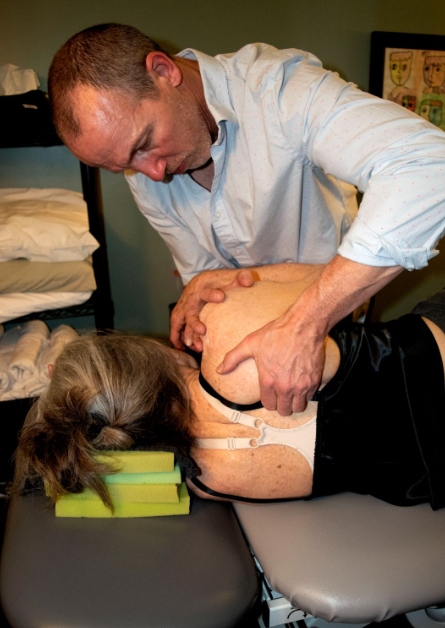
After her first session treating the shoulder blade connection to her trigeminal neuralgia, three things happened:
Her facial pain decreased significantly
She slept through the night without waking from pain
She forgot to take her pain medications for an hour and a half — something she hadn’t been able to do in months
During our third session, she turned to me: “It’s like when you have a sandcastle and pour water on it and see it melt away. That’s what I feel like when you’re working with me.”
Over the following weeks, Lizzy emerged from her dark cloud. She reached about 85% improvement in her trigeminal neuralgia symptoms when her insurance stopped covering sessions. I taught her how to continue treatment on her own.
For someone who had been living in constant agony, unable to eat normally, speak without pain, or feel a breeze on her face, this transformation was remarkable.
The Anatomy That Explains It
After my success with Lizzy’s trigeminal neuralgia, I visited Regis University’s cadaver lab trying to understand what I had done. An anatomy professor gave me the answer: the subnucleus caudalis.
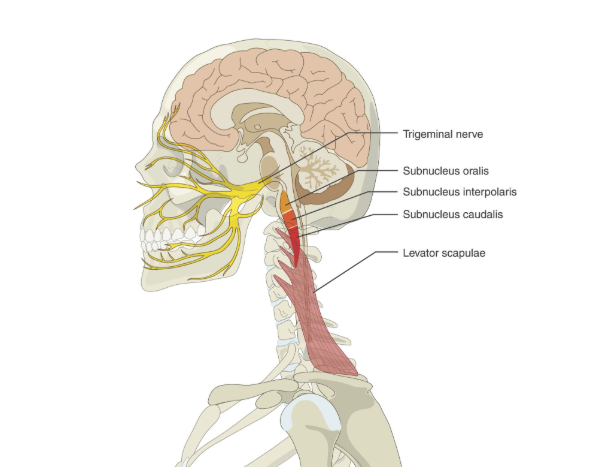
The trigeminal nerve has a central portion that extends down through the brainstem into the upper neck, around the second or third cervical vertebra below the skull.
I think of this nucleus like an egg yolk — the center of everything that happens with trigeminal neuralgia facial pain. This “egg yolk” receives pain signals and sends them to the brain.
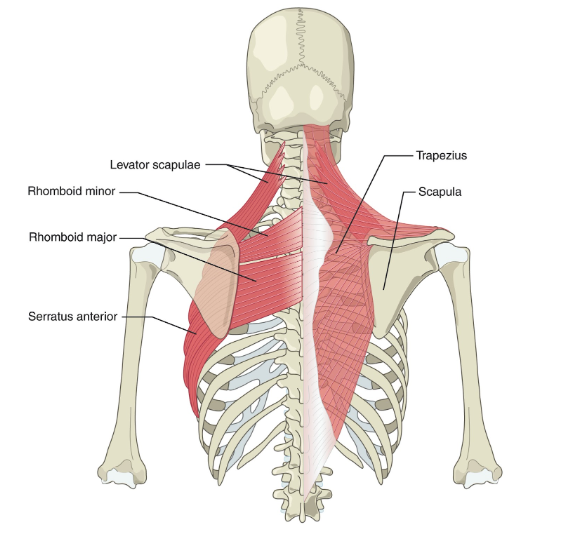
Here’s the critical connection: the shoulder blade has a muscle called the levator scapulae that attaches to the upper cervical vertebrae (C1–C4) at the same level as that trigeminal egg yolk.
When Lizzy’s shoulder blade was stuck in a bad position from her old dislocation, it was creating constant mechanical tension at exactly the wrong place, irritating the trigeminal nucleus and causing her severe facial pain.
▶️ Watch my full explanation of this anatomy on YouTube.
The Science Behind the Shoulder–TN Connection
This isn’t alternative medicine or speculation. The anatomical connections I’m describing are well-established in medical literature.
The Myodural Bridge
In 1995, researchers discovered the “myodural bridge,” direct connective tissue linking suboccipital neck muscles to the dura mater, the protective covering of the spinal cord.
This bridge provides both passive and active anchoring of the spinal cord and is involved in transmitting mechanical forces from muscle tension to the dura mater. When neck muscles are chronically tight from shoulder blade dysfunction, this tension transmits directly to the spinal cord covering.
The Trigeminocervical Complex
Mainstream neurology recognizes the “trigeminocervical complex” where signals from the trigeminal nerve and upper cervical spine converge.
Research published in Current Pain and Headache Reports states this complex “allows the bidirectional referral of painful sensations between the neck and trigeminal sensory receptive fields of the face and head.”
This means pain signals from neck dysfunction can be interpreted as face pain, and vice versa. It’s established anatomy that simply hasn’t been connected to shoulder blade dysfunction before.
The Dura Mater Connection
The dura mater is firmly attached at the C2–C3 level. When the levator scapulae (attached at C1–C4) is under chronic tension from a poorly positioned shoulder blade, it creates mechanical stress on these vertebrae, which transmits to the dura mater.
This dural tension can irritate the subnucleus caudalis of the trigeminal nerve, potentially triggering or exacerbating trigeminal neuralgia symptoms.
The Problem with Vascular Compression Theory
The currently accepted medical model for trigeminal neuralgia is vascular compression: a blood vessel, usually an artery, pressing on the trigeminal nerve near the brainstem.
This pressure supposedly damages the nerve’s protective myelin coating and causes it to misfire, creating the electric shock-like pain characteristic of TN. Surgery aims to separate the artery from the nerve.
But there’s a significant problem with this theory.
If blood vessel compression causes trigeminal neuralgia, you’d expect people without TN to not have that compression.
If 7 out of 10 people have the same “problem” that supposedly causes trigeminal neuralgia but experience no pain, then vascular contact alone can’t be the whole story.
Something else determines who develops trigeminal neuralgia pain and who doesn’t.
Could that “something else” be mechanical stress from shoulder blade dysfunction?
Why Trigeminal Neuralgia Surgery Often Fails
Gamma Knife radiosurgery for trigeminal neuralgia shows 70% initial success. But at 3 years, only 40–55% still have relief.
At 10 years? Just 25%.
If surgery fixes the cause of trigeminal neuralgia, why does pain return for 3 out of 4 patients within a decade?
This high recurrence rate suggests that vascular compression may not be the root cause for many patients. Surgery addresses what’s visible on imaging (the blood vessel contact) but may miss the mechanical factors driving the nerve irritation.
If the real driver of trigeminal neuralgia is mechanical stress transmitted through the shoulder blade → levator scapulae → cervical vertebrae → dura mater → trigeminal nucleus pathway, then surgery on the nerve itself won’t address the underlying problem.
The pain returns because the mechanical stress never stopped.
A Different Explanation for Trigeminal Neuralgia
Based on Lizzy and other trigeminal neuralgia patients I’ve treated, here’s what I believe may be happening in cases where the shoulder blade connection is relevant:
Shoulder blade dysfunction (from injury, poor posture, or repetitive strain) creates chronic tension in the levator scapulae muscle
This pulls on the C1–C4 vertebrae where the muscle attaches
Creating tension in the dura mater (firmly attached at C2–C3)
Irritating the trigeminal subnucleus caudalis at that level, causing facial pain
This mechanical explanation accounts for several puzzling aspects of trigeminal neuralgia:
Why 95–99% of TN cases affect only one side: Shoulder blade dysfunction is typically asymmetrical. If the left shoulder blade is dysfunctional, it creates left-sided cervical tension, potentially causing left-sided facial pain.
Why vascular contact doesn’t cause pain in most people: You may need this additional mechanical factor. Vascular contact + mechanical stress could be a “two-hit model” where both are needed to trigger symptoms.
Could Your Shoulder Blade Be Causing Your Trigeminal Neuralgia?
I’m not claiming this explains every case of trigeminal neuralgia. Some cases may indeed be purely vascular. Others may have different contributing factors.
But consider these questions:
- Do you have a history of trauma to the same side as your trigeminal neuralgia? (shoulder injury, car accident, fall, repetitive strain)
- Did your symptoms start after a physical activity or injury, like Lizzy’s yoga class?
- Do you have chronic neck tension or pain on the same side as your facial pain?
- Have you had unsuccessful trigeminal neuralgia surgery with pain recurrence?
- Do you notice your facial pain worsens with certain shoulder or arm positions?
If you answered yes to any of these, your shoulder blade mechanics might be worth investigating as a potential contributor to your trigeminal neuralgia.
What to Look for in a Healthcare Provider
For patients suffering from trigeminal neuralgia, there may be a mechanical path worth exploring, one that doesn’t require brain surgery.
Look for a physical therapist or manual therapist who:
- Understands and assesses shoulder blade positioning landmarks at rest and during movement
- Checks for asymmetries between left and right shoulders
- Understands the levator scapulae and upper trapezius connections to the cervical spine
- Looks at you as a complete biomechanical system, not just isolated parts
- Is willing to investigate connections between distant body regions
Traditional trigeminal neuralgia treatment focuses on medication to calm nerve activity or surgery to address vascular compression. These can be helpful and necessary.
But if there’s a mechanical component driving your trigeminal neuralgia, medication and surgery alone may not solve the problem permanently. It’s like taking painkillers for a rock in your shoe. The pain might diminish, but you’ll never fix the problem until you remove the rock.
In Lizzy’s case, the “rock” was her shoulder blade position creating chronic tension on her upper cervical spine and trigeminal nucleus.
Sometimes the answer isn’t where the pain is.
📚 Read my book: Pain Patterns: Why You Are in Pain and How to Stop It
This book reveals how system-wide mechanics — not isolated issues — drive pain, from your neck to your feet. Available now on Amazon.
🏃 Try my digital programs at rickolderman.com/ and use code RICKBLOG20 for 20% off.
🎥 Watch my YouTube videos for guided exercises and movement tutorials: youtube.com/@RickOldermanPT
Frequently Asked Questions
Based on my clinical experience, shoulder blade dysfunction can be a primary driver of trigeminal neuralgia symptoms in some patients, not just an aggravating factor. The anatomical pathway through the levator scapulae, cervical vertebrae, dura mater, and trigeminal subnucleus caudalis provides a direct mechanical connection. In Lizzy’s case, correcting her shoulder blade position led to 85% improvement, suggesting it was a primary cause, not just a contributor.
Absolutely. While acute injuries like Lizzy’s shoulder dislocation are one cause of shoulder blade dysfunction, poor posture, repetitive activities, desk work, or even old injuries you’ve forgotten can create chronic positioning problems. These develop gradually over years and may not be obvious. The dysfunction can exist long before trigeminal neuralgia symptoms appear.
In Lizzy’s case, significant improvement came after the first session. However, everyone is different. Some patients need several weeks of treatment to retrain the muscles and establish new movement patterns. The key is addressing the root mechanical cause, not just temporarily relieving symptoms. If shoulder blade dysfunction is truly contributing to your TN, you should see some improvement within the first few sessions.
Never stop prescribed medication without consulting your neurologist or pain specialist. Ideally, work with both your medical team and a skilled physical therapist who understands these connections. As mechanical issues improve, you and your doctor can discuss whether medication adjustments are appropriate. Many patients are able to reduce medications as their mechanical dysfunction improves.
This is actually a situation where investigating shoulder blade mechanics makes particular sense. If surgery addressed vascular compression but your pain returned, it suggests something else may be driving the nerve irritation. The mechanical pathway through the shoulder blade is worth exploring. Many post-surgical TN patients have found relief through addressing biomechanical factors that surgery couldn’t fix.