Neck, headaches & shoulder
Why your shoulder pain keeps coming back: your shoulder blade may be the problem
Your shoulder blade is supposed to move. If it doesn’t, your rotator cuff pays the price.
Licensed orthopedic physical therapist with 30 years of clinical experience, former owner of an
orthopedic PT clinic, and author of the Fixing You book series, including
Fixing You: Shoulder & Elbow Pain and the award-winning Pain Patterns
(2025 NIEA Award winner). He created an APTA-approved continuing education course teaching other
clinicians his systems-thinking approach to chronic pain.
Your shoulder blade normally contributes roughly 60 degrees of rotation when you raise your arm overhead. Most people I test are lucky to get 30.
Barbara was a fit, avid rock climber in her thirties who also worked as a computer programmer. She’d had surgery on her right shoulder two years before I saw her, and it had helped — some. But she still had pain in the front of her shoulder, couldn’t climb, and couldn’t strength train. She’d been to several people for help. Nothing had stuck.
I checked her shoulder blade against the landmarks I use with every shoulder patient. Her right scapula was sitting too close to her spine, about two inches instead of the three inches it should have been resting at. When her arm went overhead, it barely rotated or slid outward at all.
I asked her to simply let her scapula rest an inch further from her spine. Once I showed her where that mark actually was, I asked her to raise her arm overhead again.
“No pain,” she said, surprised. “Wow. You mean it was that simple?”
It was, for her. Every time her pain came back over the following weeks, we found the same thing: her scapula had crept back in toward her spine. Every time I showed her where it belonged, the pain disappeared again.
— Rick’s case notes
Not every case resolves this fast. Barbara’s did because her strength and range of motion were otherwise good — she just needed to relearn where her shoulder blade actually belonged. Most people I see have more stacked on top of that. But her case shows what’s possible once you’re looking in the right place.
The shoulder blade: a floating system with precise rules
Almost every joint in your body is built on compression: one bone resting on top of another, held there partly by gravity. Your shoulder system is different. It floats. Its only bony attachment to your skeleton is the collarbone, at the front of your chest. Everything else — its resting position, its ability to move — is held entirely by muscle: the trapezius, levator scapulae, serratus anterior, and rhomboids.
That freedom is also the problem. The shoulder blade has to hit precise positions, at rest and in motion, or the shoulder joint pays the price.
The landmarks
What I check on every shoulder patient
- At rest, the top of the shoulder blade sits at T2 or T3 — the second or third thoracic vertebra.
- At rest, the inner border sits about three inches from the spine.
- Overhead, the shoulder blade rotates about 60 degrees. In my experience, if I can get someone to 40 or 45 degrees, they can usually function without pain, assuming everything else is in reasonable shape.
- Overhead, the bottom corner slides out to roughly the midpoint of your rib cage — about where a shirt’s side seam sits.
- Overhead, the top of the shoulder blade elevates to about C7, the base of your neck.

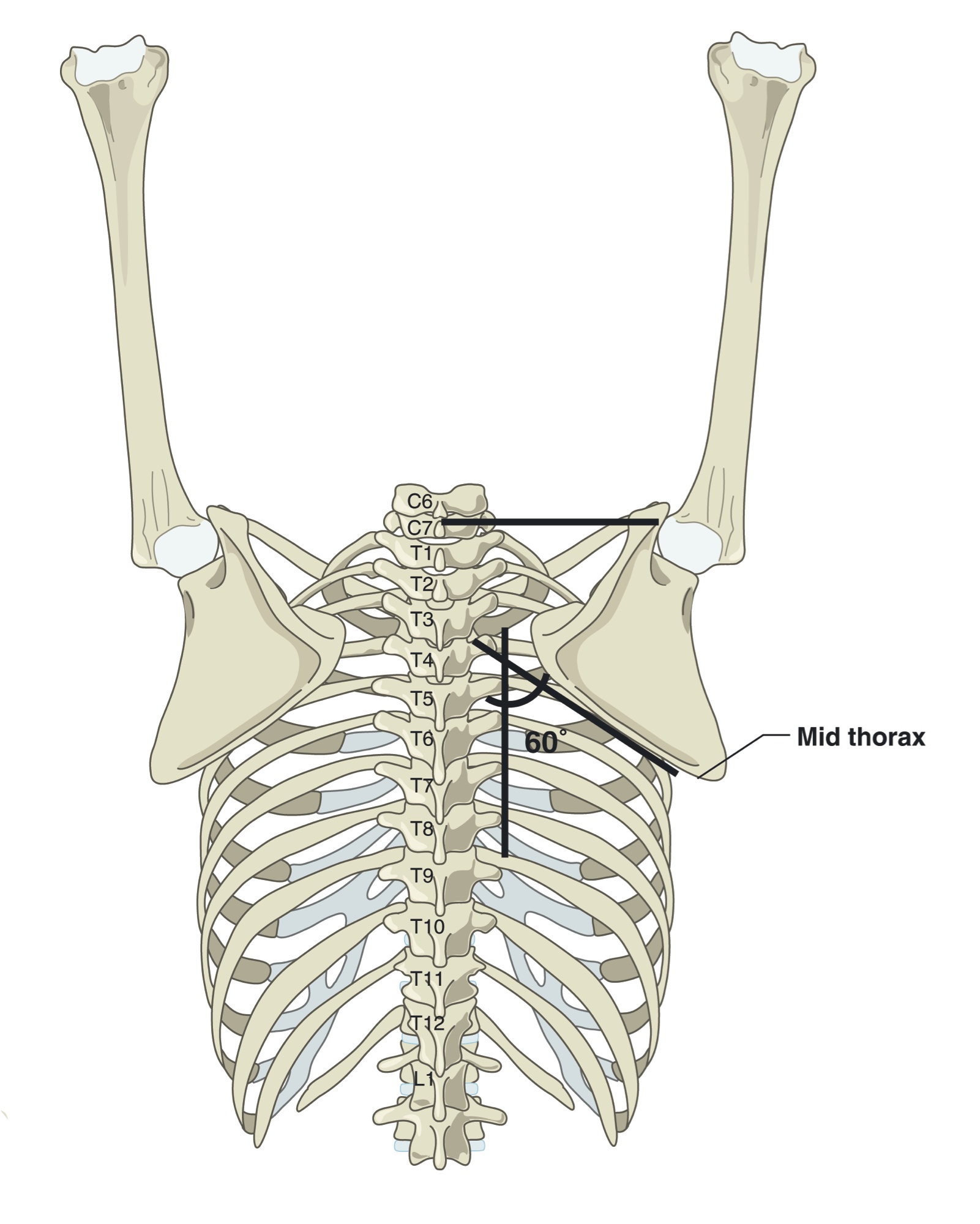
Normal shoulder flexion — raising your arm all the way overhead — totals about 180 degrees. Of that, roughly 120 degrees comes from the shoulder joint itself and 60 degrees from the shoulder blade rotating underneath it, meaning the shoulder blade contributes roughly a third of the total movement.1 Every degree it falls short, the shoulder joint has to make up some of the difference — which means more stress lands on the rotator cuff, the labrum, the AC joint, and the joint surfaces themselves.
Watch the video version
The five landmarks and two fixes, demonstrated.
There’s also a timing element called scapulohumeral rhythm. The first 30 degrees of arm elevation is the “setting phase,” where the scapula contributes very little — one inclinometer study measured it at only 2.53% of total shoulder motion in that range. Past 30 degrees, the scapula engages substantially, contributing 21% to 38% of total motion between 30 and 90 degrees.2 Unfortunately, most of our daily activities fall below that threshold. Typing, driving, most racquet sports — none of it asks much of the shoulder blade. That isn’t really a problem until the day it’s finally asked to support an overhead motion and can’t.
Research on scapular dyskinesis — the general term for a shoulder blade that isn’t resting or moving the way it should — has found it in 97.6% of people being treated for a shoulder injury, compared to 69% of their own uninjured shoulders.3 The more severe grade was present in 54.7% of injured shoulders versus only 6.7% of the healthy side, and everyone in that study whose symptoms had lasted more than six years had that more severe grade. Scapular dyskinesis has also been specifically linked to shoulder impingement, rotator cuff tendinopathy, rotator cuff tears, and shoulder instability across multiple studies.4
Strangely, at least one study found that eliminating shoulder pain with an injection — without changing anything else — partially normalized the scapula’s movement pattern on its own, suggesting pain itself can drive some of the dysfunction, not just the other way around.5 My read after 30 years of watching this resolve in the clinic is that it usually runs both directions at once: a shoulder blade that isn’t doing its job creates the pain, and once there’s pain, the body protects the area further, making the shoulder blade move even less. Either way, restoring the shoulder blade’s actual position and movement is where I start, because in my experience it’s the piece almost nobody else is checking.
Why this often gets worse, not better, after surgery
If you’ve had shoulder surgery and the pain didn’t fully resolve, or came back, I have a theory about why — partially based on my own recovery from a labral repair.
Normally, the shoulder blade helps push the arm up. After surgery, I’ve found the relationship often runs backward: the arm drags the shoulder blade along with it instead. My best explanation is that the rotator cuff muscles go into something like a protective spasm, shorten from weeks of immobilization in a sling, or are partly disconnected from the brain’s normal signal to them. That last piece is called arthrogenic muscle inhibition — a neurological reflex where altered signalling from the joint itself reduces the nervous system’s ability to fully activate the surrounding muscles, even when the muscle isn’t damaged. It’s been measured directly in the shoulder after rotator cuff repair, where one study found significant external rotation weakness at just 10 days post-surgery that direct electrical stimulation of the infraspinatus could partially overcome.6
I also consistently find specific weakness in the mid trapezius and serratus anterior after surgery, more pronounced than I typically see from injury alone. This matches research on post-repair scapular muscle activity, which has found the upper trapezius firing early and staying overactive while the serratus anterior, middle trapezius, and lower trapezius show reduced or delayed activation.7
This tracks with what the research shows. In one study of patients with rotator cuff tears, 65.7% had scapular dyskinesis before surgery. After a successful repair, only about half of those cases actually improved.8 Standard post-surgical rehab understandably focuses heavily on restoring range of motion and rebuilding rotator cuff strength. What’s often underemphasized is measuring and retraining how the shoulder blade is contributing to that movement in the first place.
Watch
Why shoulder pain persists after rotator cuff surgery, and what I believe is actually going on.
Why standard shoulder rehab usually misses this
This isn’t unique to post-surgical care. It’s the standard everywhere. The current clinical practice guideline most physical therapists are trained against for rotator cuff issues lists the standard goals as reducing pain, restoring range of motion, and strengthening the muscles around the joint.9 Tracking shoulder blade motion seems to have been forgotten or dismissed. It’s not that practitioners are doing bad work — they’re following the established standard of care.
Testing your own shoulder blade
Try this test
The palm test
- If your pain shows up when raising your arm out to the side or forward, note exactly where it starts.
- Try the same movement again with your palm facing up instead of down.
- Compare.
Palm down, the head of your arm bone tends to bump into the underside of your acromion — the bony roof of your shoulder — pinching whatever’s in that narrow space. Palm up rotates that same tissue out of the way. If turning your palm up reduces or eliminates the pain, that’s a clue your shoulder blade mechanics are contributing to what you’re feeling.
Why shoulder blades end up out of position
A few patterns show up again and again.
A cue sometimes used in yoga, Pilates, dance, and gymnastics. These disciplines commonly aspire to a long, elegant neck line, and one common cue for it is pinning the shoulder blades down and together. That cue works against the shoulder blade’s need to elevate and rotate as the arm goes overhead. I’m a Pilates instructor myself, so this isn’t a criticism of the disciplines — it’s a criticism of a specific, widespread cue that works against how the shoulder actually moves.
Sports and training built around the front and back muscles instead of the shoulder blade. Heavy chest and back training, without matching attention to the shoulder blade, tends to build exactly the muscles that pull the arm bone inward and the shoulder blade down and forward. Watch someone who lifts heavily but never trains their shoulder blade: their arms often hang with palms facing backward at rest rather than in toward the hips, a sign of tight internal rotators dominating the joint.
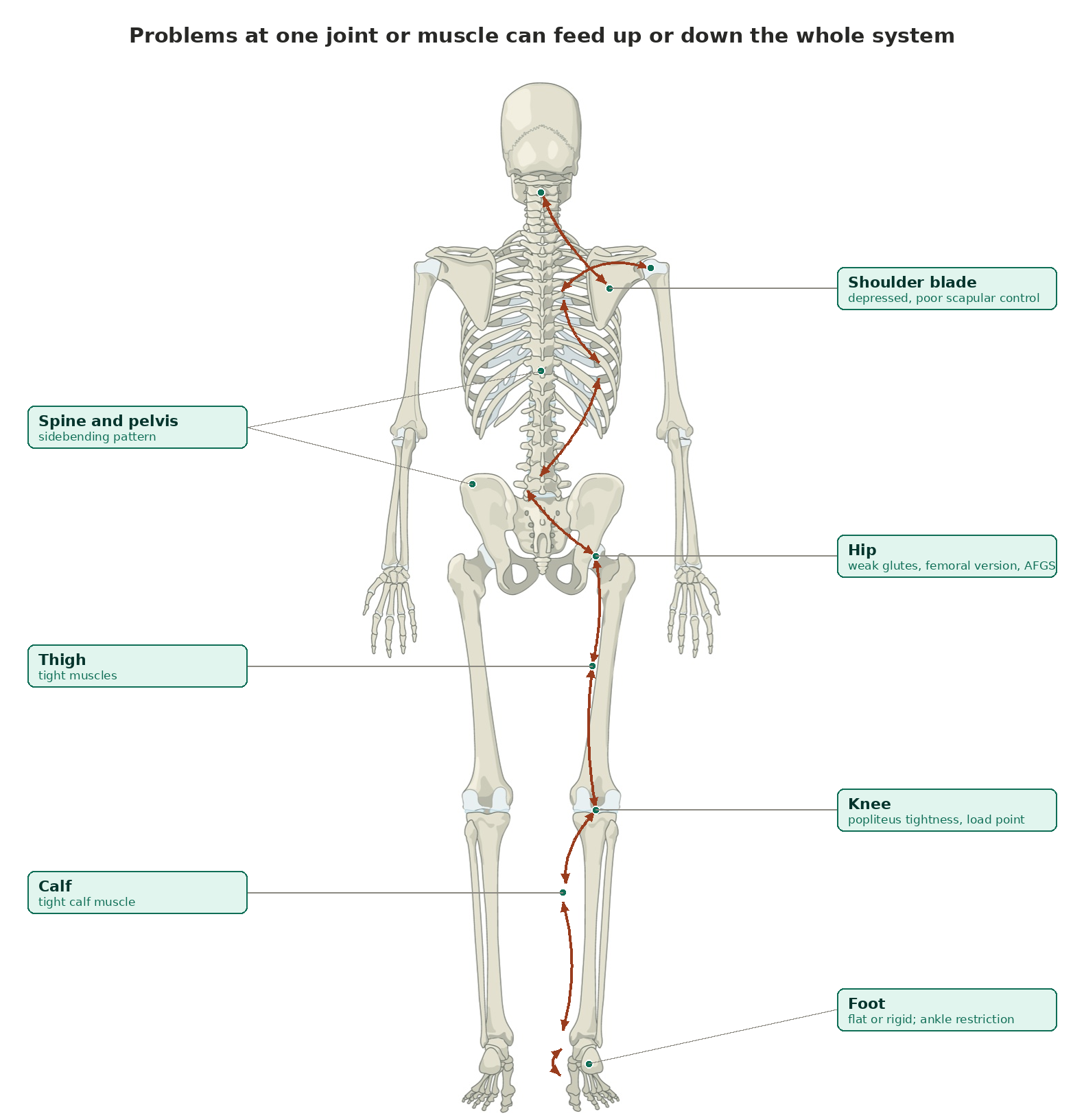
An old, unrelated injury lower in the body. The shoulder blade rests on the rib cage. If the rib cage sits lower on one side — what I call a sidebending problem, usually due to a problem in the lower body — the shoulder blade sitting on top of it will be lower too. I go into more detail, including the test and the fix, in my sciatica article. It can easily show up as a one-sided shoulder problem instead.
Watch
Why activities like pickleball rarely trigger the shoulder blade to correct itself on its own.
Twenty years of shoulder pain, three stacked problems
Gary had shoulder pain for two decades, dating back to playing college football and baseball. It would settle down whenever he stopped lifting weights, then flare right back up the moment he tried to train again.
When I evaluated him, I found three separate issues: his shoulder blade sat too low and too far from his spine; his upper arm bone was rotated inward more than it should be; and the head of that arm bone was sitting too far forward in the socket, referred to as anterior humeral glide syndrome.
Any one of those alone would strain a shoulder. Together, over 20 years of training, they’d worn the joint down considerably.
We started with range of motion, not strength — restoring shoulder blade and arm bone motion. Only once that foundation was back in place did we add targeted strengthening for the muscles actually responsible for controlling the shoulder blade.
— Rick’s case notes
In the same research on scapular dyskinesis mentioned earlier, every patient whose shoulder symptoms had lasted more than six years showed the most severe grade of dysfunction.3 Gary’s twenty-year history matched the pattern I see clinically in cases like this. Fixing the joint that hurt had nothing to do with directly treating that joint, and everything to do with restoring the mechanics of the shoulder blade.
Fixing a shoulder blade that isn’t doing its job
Try this
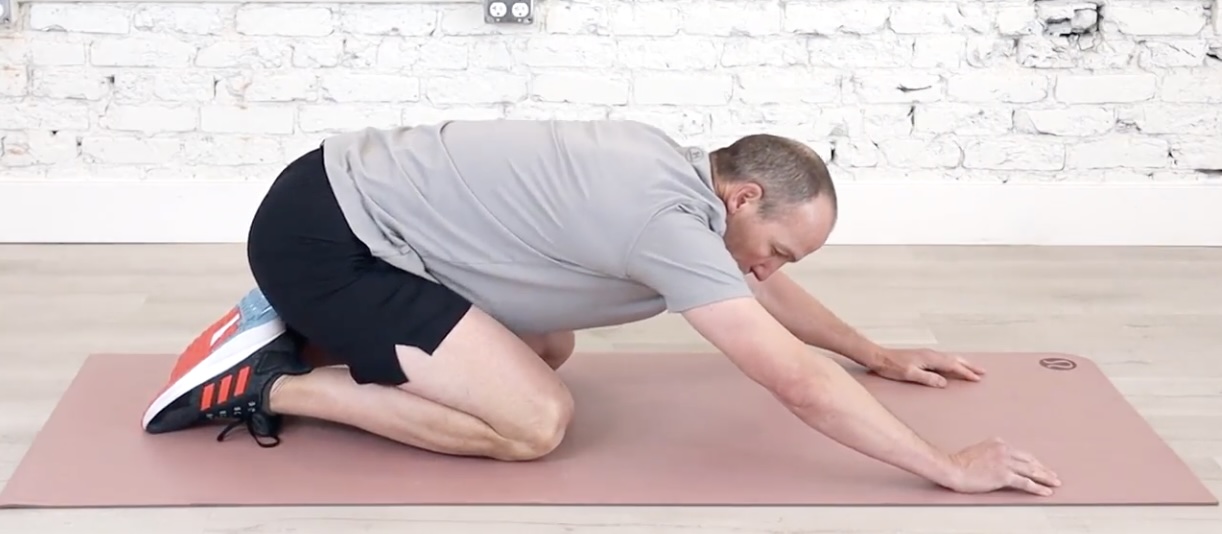
All-fours rocking
- Get on your hands and knees, hands planted.
- Sit back toward your heels while your hands stay where they are.
- Because your hands are anchored, your body moving away from them passively drags your arms and shoulder blades into the elevated, rotated position they’re supposed to reach on their own.
Most people feel an immediate difference in overhead pain after even one or two rounds. This is the same stretch I recommend for the neck and back.
Try this
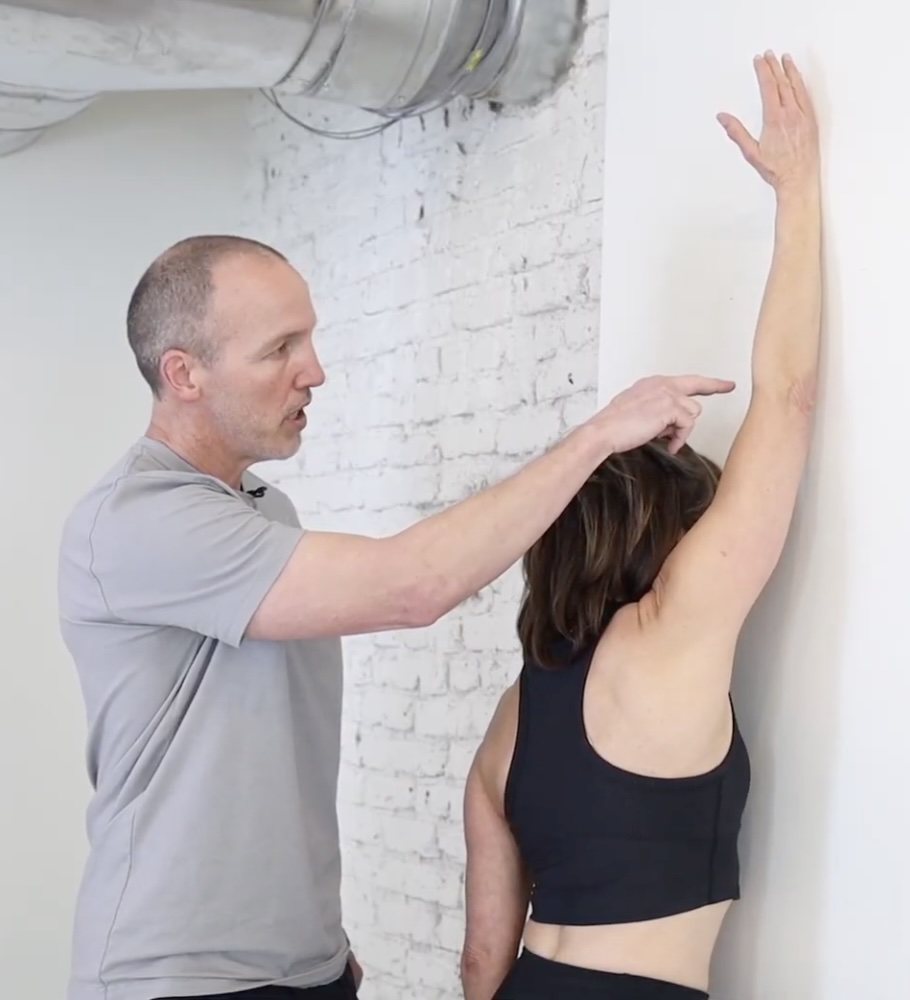
Wall slides
- Slide your hand up a wall.
- Once your elbow reaches roughly shoulder height, actively push your arm the rest of the way up using your shoulder blade.
- Keep it engaged as you lower slowly, until your elbow drops back below shoulder height.
This retrains the timing itself — the scapulohumeral rhythm described earlier — so your shoulder blade learns to engage right when it’s supposed to.
If you’re facing a surgery decision
This article is focused on shoulder pain generally, not on post-surgical rehab step by step or the decision of whether to have surgery. But depending on where you are, two things.
If you’re still deciding, or weighing a second opinion, I wrote a separate article on what the research actually says about arthroscopic surgery versus physical therapy: Meniscus, rotator cuff, or labrum surgery? What the research actually says. I’d start there before making a decision.
If you’ve already had surgery and are still dealing with pain or restricted motion, I went through my own shoulder surgery — a labral repair with a biceps tenodesis — and documented my recovery as it happened.
Putting it together
Barbara’s scapula sitting too close to her spine. Gary’s twenty years of mechanical problems. Both were shoulder joint pain. Neither was actually a shoulder joint problem in the traditional sense. In both cases, and in most of the chronic shoulder pain I see, the shoulder blade was the piece nobody had measured — and the piece that mattered most.
Rick’s takeaway
Strengthening a rotator cuff that’s compensating for a shoulder blade doing a third of its job is treating the wrong end of the problem. Measure where the blade rests and how far it rotates before you strengthen anything.
Common questions
Why does my shoulder pain keep coming back after physical therapy?
Standard rehab is built around restoring shoulder joint range of motion and rotator cuff strength, not around measuring or retraining how the shoulder blade itself rests and moves — even though the shoulder blade comprises a large part of the shoulder joint. If the shoulder blade is still falling short of its landmarks, the joint often stays overloaded regardless of how much stronger the rotator cuff gets.
Can shoulder blade position cause rotator cuff tears?
In my clinical experience it’s frequently a major contributor, because it slowly breaks down those muscles and makes them vulnerable. Research has found scapular dyskinesis in the large majority of people being treated for shoulder injuries, including rotator cuff pathology — though the research is honest that pain itself can also drive some of that dysfunction, not only the other way around.
Why didn’t my shoulder surgery fully fix my pain?
Surgery repairs the structure that tore. It doesn’t automatically restore how your shoulder blade moves, and this is sometimes made worse by protocols requiring rest. Research shows scapular dyskinesis often persists even after a successful repair, which matches what I’ve found clinically: the shoulder blade’s movement pattern usually needs to be retrained directly, not assumed to correct itself.
Is scapular depression the same as poor posture?
Related, but not identical. Poor posture — especially the cued pattern of pinning the shoulder blades down and together — is one common driver. But an old injury elsewhere in the body, a sidebending problem affecting the rib cage, or years of below-shoulder-height activity can all produce the same result without posture being the primary cause.
What if I don’t have full-blown shoulder pain, just occasional impingement?
That’s likely a warning that something is wrong. It might be wise to check your shoulder blade mechanics now, before an occasional ache becomes a chronic problem.
Should I still see a doctor?
Yes. This isn’t a diagnosis or a substitute for medical care. If you have a specific traumatic injury, significant weakness, or symptoms that aren’t improving, get it evaluated. This article is about the mechanical driver behind a lot of chronic, non-traumatic shoulder pain, not a replacement for ruling out a structural tear.
If your landmarks came up short
The full landmark system, and the progressions that follow it
Fixing You: Shoulder & Elbow Pain walks through the complete landmark system, the rotator cuff and forearm anatomy behind it, and the corrective exercise progressions.
Fixing You: Shoulder & Elbow Pain
Want the systems-thinking framework behind all of this? Pain Patterns covers the same testing philosophy applied across the whole body.
Have a question this article didn’t answer?
Send it through the Ask Rick form. I read every question and use the most common ones to shape future articles, videos, and my monthly email — sometimes by featuring them, never with identifying details, in a public answer. I ask for your email in case I need more detail, or want to let you know when I’ve covered it.
References
- Inman VT, Saunders JB, Abbott LC. “Observations of the function of the shoulder joint.” J Bone Joint Surg Am. 1944;26(1):1–30. Established the widely-used 2:1 ratio of glenohumeral-to-scapulothoracic motion during arm elevation. Later 3D motion-tracking studies found the ratio varies considerably across the range of motion rather than remaining fixed at exactly 2:1. ↩
- Inclinometer-based study of scapular upward rotation across the arc of shoulder elevation in healthy subjects. Found the scapula contributed only 2.53% of total shoulder motion during the first 30 degrees, rising to between 20.87% and 37.53% across the 30–90 degree range. Original description of the setting phase from Inman, Saunders and Abbott, 1944. ↩
- Sim BS, Kim YK. “Prevalence and grade of scapular dyskinesis in patients with shoulder injuries: a cross-sectional study.” JSES Int. 2026;10(3):101643. Found scapular dyskinesis in 97.6% of injured shoulders versus 69% of the same patients’ uninjured shoulders; the severe grade in 54.7% versus 6.7%; and the severe grade 100% of the time in patients with symptoms lasting more than six years. ↩ ↩
- Kibler WB, McMullen J. “Scapular dyskinesis and its relation to shoulder pain.” J Am Acad Orthop Surg. 2003;11(2):142–151, and subsequent reviews documenting the association with impingement, rotator cuff tendinopathy, rotator cuff tears, and glenohumeral instability. ↩
- Study using subacromial lidocaine injection to eliminate shoulder pain in patients with rotator cuff tears found this partially normalized scapular kinematics without any structural change, suggesting pain itself contributes to scapular dyskinesis, not only the reverse. 2024. ↩
- Reinold MM, Macrina LC, Wilk KE, Dugas JR, Cain EL, Andrews JR. “The effect of neuromuscular electrical stimulation of the infraspinatus on shoulder external rotation force production after rotator cuff repair surgery.” Am J Sports Med. 2008;36(12):2317–2321. ↩
- Sun JN, Zheng QY, Wang RS, Ma YR, Chen P. “An additional rehabilitation program to improve postoperative outcomes in patients with rotator cuff tear and scapular dyskinesis: a propensity score-matched study.” BMC Musculoskelet Disord. 2025. ↩
- Song HE, Oh KS, Yoon JP, Lee DR, Baek S, Chung SW. “Improvement in scapular dyskinesis after rotator cuff repair and subacromial decompression.” Knee Surg Sports Traumatol Arthrosc. 2022;30(6):2093–2101. Found scapular dyskinesis in 65.7% of patients before surgery; of those, only 52.1% showed improved scapular kinematics after successful arthroscopic repair. ↩
- Desmeules F, Roy JS, Lafrance S, et al. “Rotator Cuff Tendinopathy Diagnosis, Nonsurgical Medical Care, and Rehabilitation: A Clinical Practice Guideline.” J Orthop Sports Phys Ther. 2025;55(4):235–274. ↩