Neck, headaches & shoulder · start here
The 30-second armpit test that could explain your neck pain, radiculopathy, or headaches
Why the standard neck workup misses the real driver, and how to check for it yourself.
Licensed orthopedic physical therapist with 30 years of clinical experience, former owner of an
orthopedic PT clinic, and author of the Fixing You book series, including
Fixing You: Neck Pain & Headaches and the award-winning Pain Patterns
(2025 NIEA Award winner). He created an APTA-approved continuing education course teaching other
clinicians his systems-thinking approach to chronic pain.
Your arms and shoulder blades weigh 15 to 25 pounds. That weight hangs off your neck and skull every minute you’re upright, whether you notice it or not.
I want to tell you about a friend of mine, Debbie. A few years before she came to me, she’d been in two car accidents that left her with chronic migraines. Medication helped a little. It wasn’t enough.
After a handful of sessions treating her neck, her migraines improved significantly. I was satisfied, and so was she. Most physical therapists would have called that a win and stopped there. I couldn’t leave it alone.
I wanted to confirm she was really better, so in our final session I gently pressed on her left shoulder two or three times, mimicking the pressure of a seatbelt catching her body during those accidents. Barely any pressure. She felt nothing.
She called the next day. Her migraines were back, and worse than they’d ever been.
I told her that was expected, which was a lie I told myself as much as her. Privately, I was stumped. For three days I turned it over. Why would a few pounds of pressure on her shoulder trigger her worst migraine in years, when I hadn’t touched her neck at all?
On the third day, driving somewhere and not really paying attention to the road, a picture of the anatomy flashed into my head: the muscles connecting the shoulder blade to the neck bones and the base of the skull. I’d learned this anatomy in school the way everyone does, as isolated facts about what muscle goes where. I’d never put the repercussions together as a chain that could deliver forces from the shoulder all the way into someone’s head.
I brought Debbie back in and looked at her differently. Her left shoulder sat noticeably lower than her right, though she was right-handed, meaning it should have rested slightly higher. Neither of us had thought this mattered. I taped her shoulder blade into a better position on the spot. She called the next day: no headache. That was the beginning of everything I now understand about the connection between the shoulder and the head.
— Rick’s case notes
Why one-sided head pain is a clue
Debbie’s migraines, like most people’s, occurred mostly on one side. Research backs this up: in a large study of migraine patients, roughly two-thirds reported headaches that were usually or always one-sided, versus less than a quarter who described their pain as typically bilateral.1
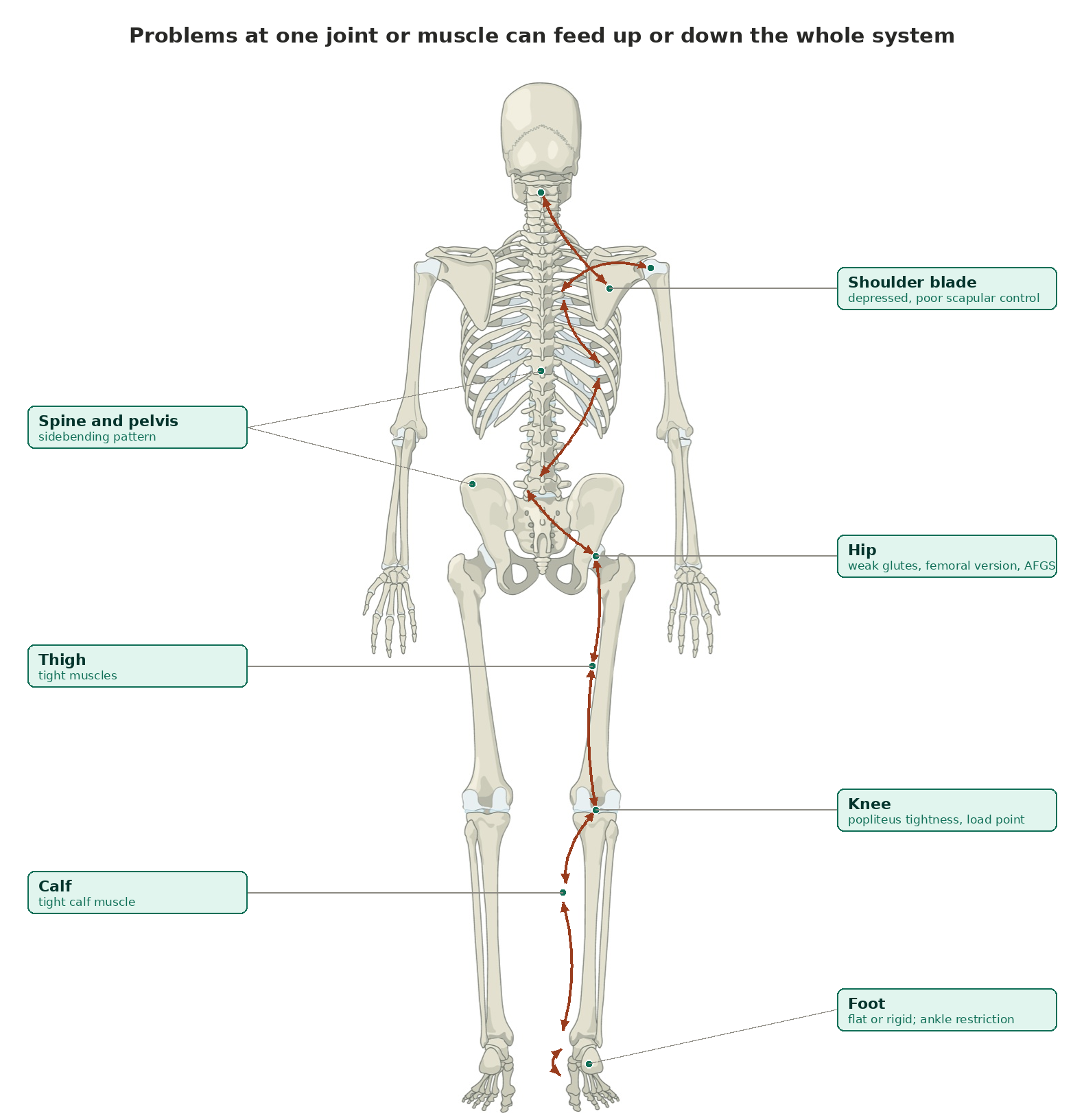
This detail matters because in my experience, when musculoskeletal pain is strongly one-sided, I start looking for an asymmetric mechanical driver. I’ve found this to hold for back pain and sciatica too, where an uneven pelvis and rib cage — what I call a sidebending problem — explains why the pain favors one side. I cover the full test and fix in my sciatica article. The same logic applies above the waist.
I think of tension headaches, migraines, and even trigeminal neuralgia as sitting on the same spectrum rather than as separate diagnoses. Tension headaches are the foothills. Migraines climb higher. Trigeminal neuralgia, one of the most painful conditions in medicine, sits at the summit. I’m not claiming migraines and tension headaches share the same underlying cause. But when I see migraine patients whose symptoms change dramatically the moment I alter the mechanics of the shoulder blade, I don’t think the migraine should be treated as completely unrelated to the musculoskeletal system — and it’s the reason I don’t approach it that way in practice.
The anatomy: a floating system connected to your skull
Unlike almost every other bone in the body, your shoulder blade doesn’t rest on top of another bone. It floats on your rib cage, held to your skeleton only by the collarbone. Several muscles run from the shoulder blade up into the cervical spine and the base of the skull — most importantly the trapezius and, underneath it, the smaller levator scapulae, which inserts directly into the top four neck vertebrae.
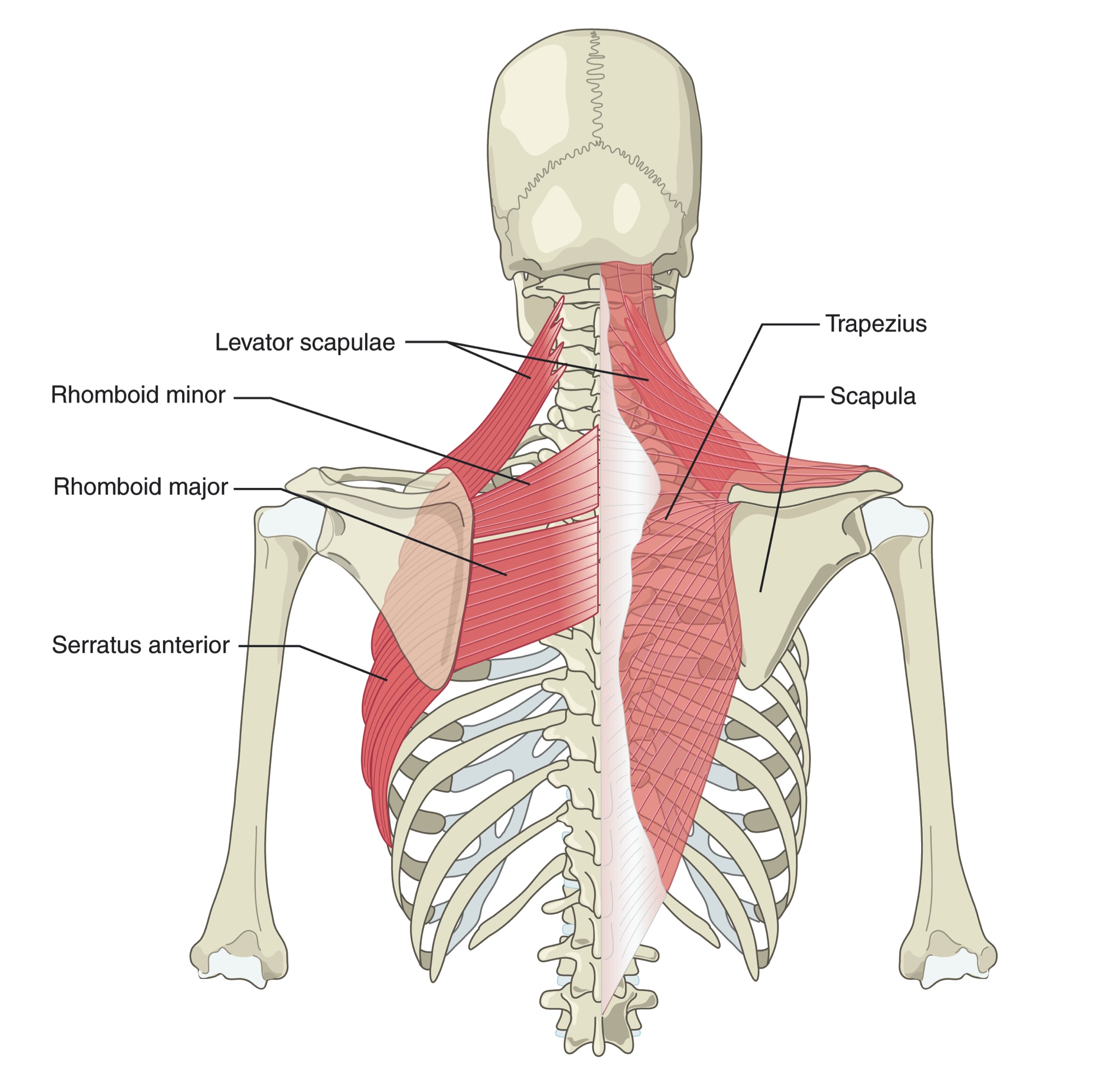
There are rules about how the shoulder blades should rest. When they rest too low — a pattern I call depressed shoulder blades — those muscular connections come under constant tension. The levator scapulae, a small muscle, ends up fighting gravity and much larger muscles in the front and back of the trunk to keep a 15 to 25 pound shoulder-and-arm system from sagging. It’s not built for that job, and it shows: compression and side-bending stress on the cervical spine, irritation of the suboccipital muscles at the skull base, and, because that compression narrows the space where nerve roots exit, radiating symptoms down the arm.
What the research supports
- A drooping, depressed shoulder position was described as far back as 1984 as a cause of thoracic outlet symptoms. Researchers found patients’ shoulder blades low enough to be radiographically confirmed, producing neck, shoulder, chest, and arm symptoms that worsened with downward traction on the arm and eased when the arms were propped up — essentially the same mechanism behind the armpit test below.2
- More recent research found that a depressed scapular alignment is associated with measurably lower pain thresholds at the cervical facet joints and increased sensitivity in the nerves running down the arm, even in people with no symptoms yet.3
- A 2024 meta-analysis pooling eight randomized controlled trials found that treating the scapula significantly reduced pain intensity in people with chronic neck pain — though it didn’t move general disability scores or pain thresholds for the group as a whole. A reminder that scapular position is a real contributor for many people, not a guaranteed explanation for everyone’s neck pain.4
- In a controlled study of chronic tension-type headache sufferers, 65% showed active trigger points in the suboccipital muscles, and pressing on those points reproduced the patients’ actual headache pattern, not just generic soreness.5
- Separate research on children with chronic tension headache found the same reproducible effect from trigger points in the upper trapezius and levator scapulae specifically — muscles that refer pain directly into the neck and head.6
- Sustained mechanical loading has also been shown to shorten and tighten the suboccipital muscles over time, altering how force moves through the upper cervical spine.7
What none of this research tests directly is my full clinical model: that a chronically depressed shoulder blade is the upstream driver connecting all of it — from thoracic-outlet-type nerve traction, to cervical facet sensitization, to suboccipital trigger points — and that tension headaches and migraines represent one continuous spectrum of the same underlying mechanical pattern rather than separate conditions. Each individual link in that chain now has research behind it. Connecting all of them into one unified explanation, and tracing it back specifically to shoulder blade position, is the synthesis I’ve built from 30 years in the clinic. I call this systems thinking.
Your MRI or X-ray may well show arthritic changes, disc changes, or ligament wear in your cervical spine. My clinical suspicion, built on three decades of seeing these cases, is that mechanical loading from the shoulder system may contribute to some of the forces that eventually produce those structural changes. A cervical-spine-specific finite element study found that as intervertebral discs degenerate, the resulting shift in load distribution increases strain and stress directly in the adjacent bone — the mechanical trigger thought to drive bone spur formation.8 A 2025 case report went further, describing a patient whose decades of asymmetric arm use at work were proposed as the driver of one-sided facet joint degeneration and a large osteophyte at the exact cervical level under that strain.9 Neither study tested scapular position as the driver of that loading. That’s my clinical extension, not something either paper set out to prove.
Why standard care usually misses this
When you go in for chronic neck pain or headaches, the imaging ordered is almost always of your cervical spine. Nobody images the shoulder blade system, because nobody’s looking there. Treatment typically follows the same logic: massage, dry needling, or strengthening aimed at the neck muscles themselves, which are numerous and an obvious target.
These interventions aren’t wrong, exactly. They’re incomplete — similar to how sciatica gets blamed on the piriformis or a disc without asking what’s driving the piriformis to overwork in the first place. Treating the suboccipital muscles or the upper traps, or manipulating a vertebra or two, can bring relief. It just doesn’t last if the shoulder blades are still dragging on those same muscles the next day, and the next.
If you have radiating symptoms down your arm, the same mechanical forces may be worth investigating. Medicine generally treats radiculopathy as coming from cervical nerve root compression, full stop. In my experience, that’s often only half the story. The other half is why those tissues are irritated enough to produce symptoms in the first place. A depressed shoulder can increase tension through the tissues surrounding the brachial plexus and cervical nerve roots — the same mechanism described in the shoulder-droop research above.2 The more that tension builds, the more readily even small additional pressure produces numbness or tingling down the arm.
This ties back to the unilateral clue above. If your radiculopathy runs down one arm rather than both, that’s the same signal as one-sided headache pain: it points toward an asymmetric, mechanical driver worth investigating rather than a purely structural or systemic one.
Watch the video version
Why I believe the shoulder blade is the most overlooked source of chronic headaches.
The armpit test
Let’s see whether your shoulder blades might be contributing to your neck pain, radiculopathy, or headaches. You’ll need a helper for this one.
Try this test
The 30-second armpit test
- Move your head through its full range: turn left and right, look up and down. Note where pain or restriction begins, and rate it 0 to 10. Be specific: “turning my head 30 degrees left produces 6/10 pain,” not just “it hurts.”
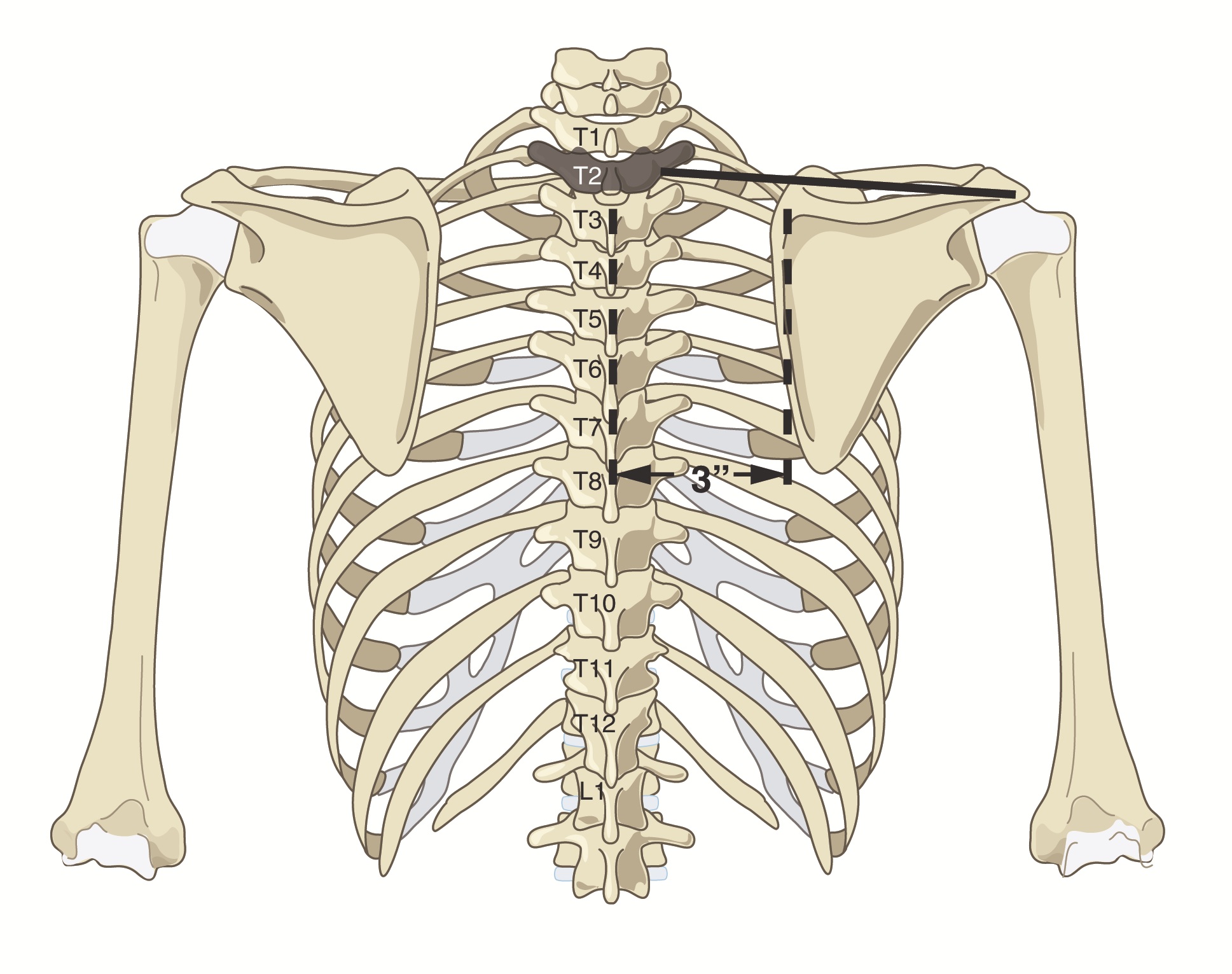
- Have your helper stand behind you, place their hands in your armpits, and lift your shoulders about an inch higher than normal. Your only job is to go completely limp and let them hold the full weight of your shoulder system. Don’t help them — that re-engages the muscles you’re trying to unload. Your helper should be strong enough to hold this for 30 to 60 seconds, jiggling gently if you’re having trouble relaxing.
- While your helper is still holding, retest your neck range of motion. More movement? Less pain? A sense of relief? Some people feel pain disappear entirely. If you can’t tell the difference yourself, ask your helper to watch — people often can’t detect changes I can see clearly from the outside. Better still, video yourself at step 1 and again here.
- Have your helper slowly lower your shoulders back down. Notice how quickly the pressure and restriction return. The faster it comes back, the more significant the downward forces on your shoulder blades.
The nerve bundle feeding your arm and hand runs through the armpit, so some sensation from your helper’s hands is normal. If the test produces or increases numbness, tingling, or weakness, stop the test.
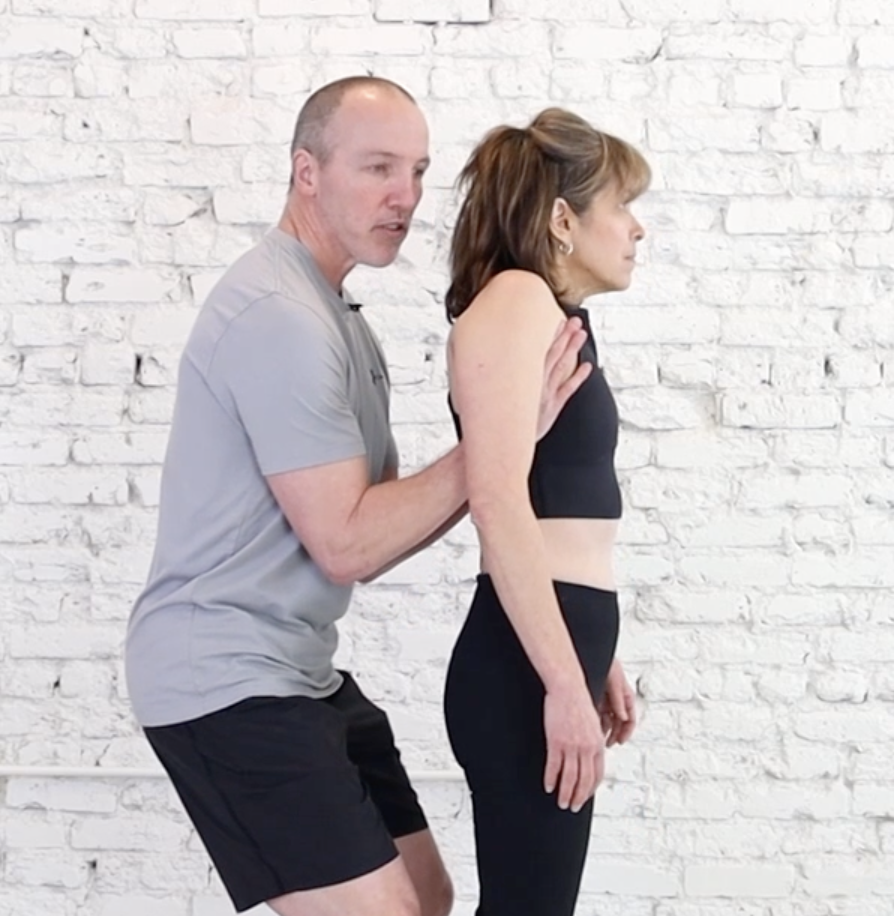
Most people feel meaningful relief while their shoulders are held up. If your symptoms change when your shoulders are unloaded, that’s a strong clue the shoulder blade system may be contributing to your pain, whatever your MRI says the cervical spine looks like. We haven’t changed those structures in 30 seconds. We’ve changed the forces acting on them. Just think what could happen if those changes held 24 hours a day instead of 30 seconds.
A positive result doesn’t tell you your shoulder is the only cause of your symptoms, or even the main one. It tells you that changing the load through your shoulder system changed your symptoms. That’s the clue. The next question is why.
Why shoulder blades end up depressed
Watch
How posture strategy contributes to depressed shoulder blades.
One cause of depressed shoulder blades is posture strategy — specifically, training from yoga, Pilates, dance, or gymnastics. All four chase the same aesthetic: a long, elegant neck. The cue that produces it — “bring your shoulder blades down and back into your back pockets,” “squeeze your shoulder blades together,” “lengthen your neck” — is repeated constantly and eventually adopted permanently. This activates key scapular depressors.
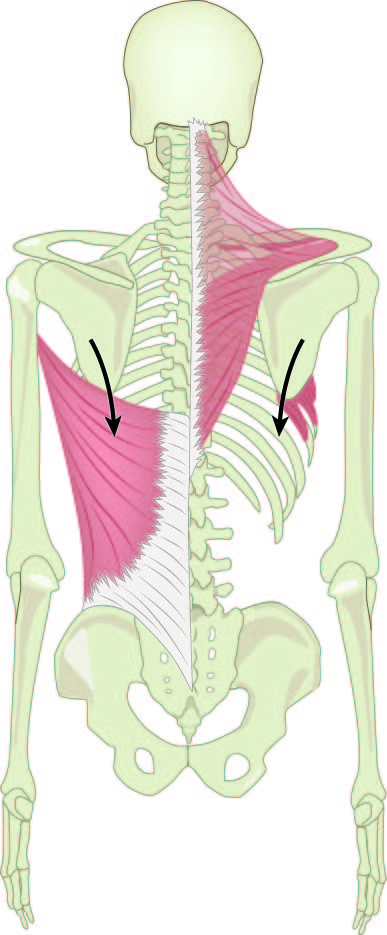
That cue is the opposite of how your shoulder blades are supposed to work. Functionally, the shoulder blade should elevate and rotate upward as you raise your arm, assisting the movement. When people pin their shoulder blades down while raising their arms overhead, it short-circuits that entire system — while chronically loading the exact muscles connecting the shoulder blade to your neck and skull. This is a hard thing to hear for someone who’s spent years in one of these disciplines, because it’s often deeply ingrained as correct posture, taught by experts. The problem is that this cue can look like good posture while creating a mechanical problem, especially when the shoulder blades are held down all day rather than allowed to move naturally.
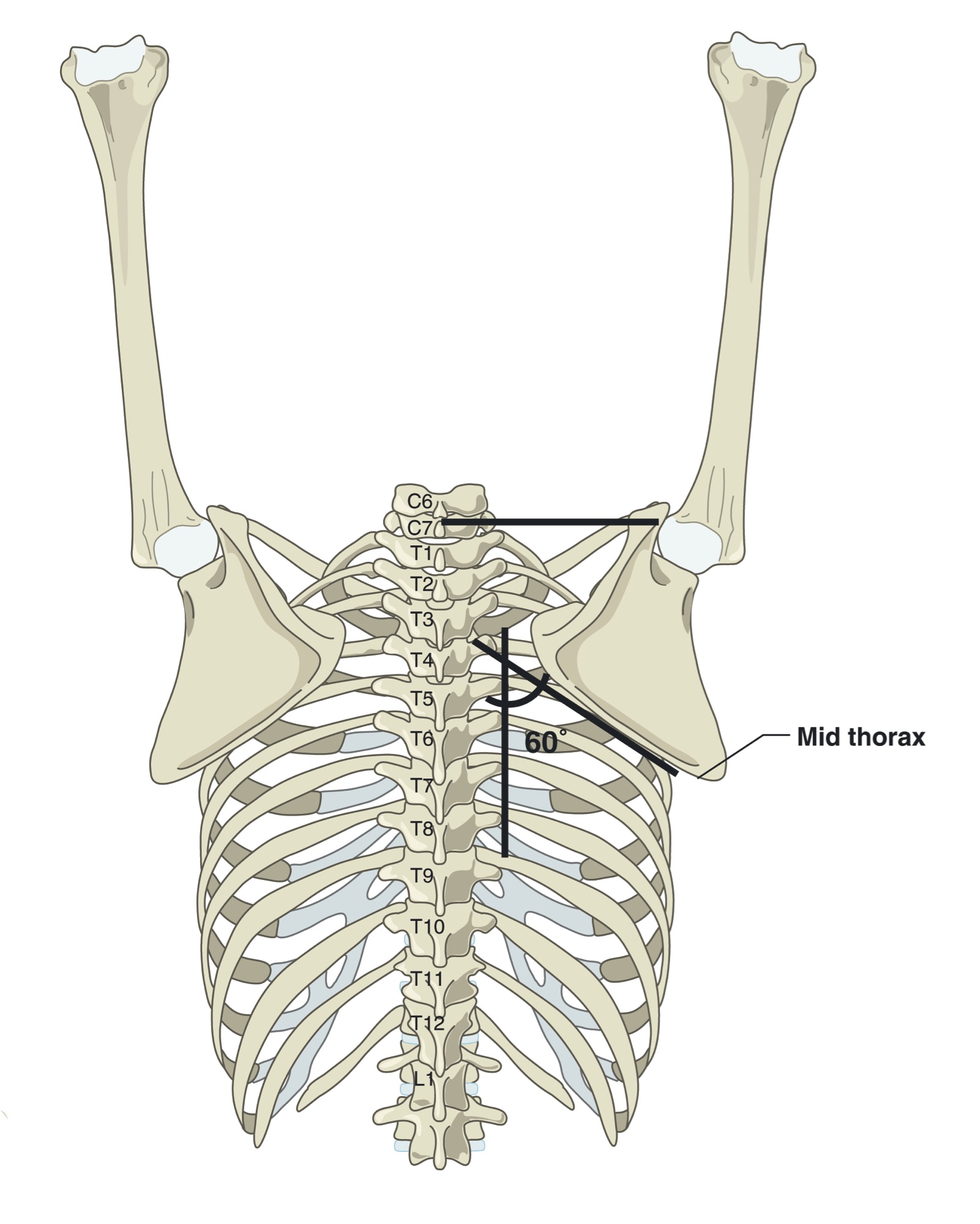
If you also have a sidebending problem — an uneven pelvis and rib cage I’ve written about in full depth in my sciatica article — that compounds the issue on the affected side. The shoulder blade rests on the rib cage, so if your rib cage sits lower on one side, your shoulder blade sits lower there too, stacking a second downward force onto the same shoulder.
Three neck pains that were shoulder problems
Barb was an ER nurse, decades of experience, not someone easily rattled. She came in with severe neck pain and headaches going back on and off for years. She’d already tried chiropractic care, massage, a strong pain reliever, and trigger point injections in a matter of weeks. Taping her shoulder blades into a better position eliminated her neck pain and headaches almost immediately. She was still skeptical. Her yoga practice had trained her to pin her shoulder blades down and together for years, and when I tested her, she couldn’t activate the muscles that were supposed to hold her shoulder blades up. That told me this was old, not new. Her pain only stayed away while she wore the tape. When she finally agreed to a shoulder MRI to settle the argument, it showed full-thickness rotator cuff tears in both shoulders. After surgery to repair them, her headaches and neck pain resolved and stayed gone.
Sharon, in her mid-30s, came in with years of neck pain and migraines on both sides, worse on the right, with occasional numbness in her hands. The same shoulder-blade approach resolved her left-sided pain within weeks. Her right side didn’t respond, and taping only helped temporarily. Her first shoulder MRI came back clean, which her surgeon took as evidence her shoulder wasn’t the problem. I wasn’t convinced; a standard MRI without contrast dye can miss labral damage, especially in a joint as structurally complex as the shoulder. A second surgeon agreed to exploratory surgery if six more weeks of conservative treatment didn’t resolve it. It didn’t. Surgery found two massive labral tears, among the largest that surgeon had ever repaired. Her neck pain and migraines disappeared almost immediately afterward.
Alex was built like an NFL lineman, strong through nearly every test I ran, with one glaring exception: his mid trapezius tested markedly weak on his painful side. Strengthening it, combined with taping and manual work, resolved his chronic neck pain for a few weeks at a time. But it kept returning. His shoulder MRI showed labral fraying and small tears in two rotator cuff muscles. His surgeon didn’t consider them significant enough to operate on, correctly noting Alex was functioning at a high level despite them, and offered a cortisone shot instead. That shot eliminated his neck pain completely — strengthening my suspicion that his shoulder, not his neck, was the actual source.
— Rick’s case notes
Three different patients, three different structural findings, and a pattern I kept seeing: when we finally addressed the shoulder, the neck and head symptoms changed.
Watch
A real clinic session assessing shoulder blade height and correcting chronic neck pain, live.
Fixing depressed shoulder blades
Two exercises can help a lot, and I’ve already walked through both elsewhere.
All-fours rocking lengthens the muscles pulling your shoulder blades down, passively restoring the elevated, upwardly rotated position they should rest in. Many people notice a reduction in pain immediately after doing this stretch, which is itself more evidence that the shoulder system is a real contributor. I walk through it in the shoulder article.
Lifting the rib cage retrains your posture strategy so your core, not your shoulder blades, does the work of holding you upright. I cover the full technique in the back pain article, and it applies here without modification.
And finally, when sitting down at the end of the day to watch TV, prop up your shoulder on a pillow with your hand resting on top. This takes the weight of the shoulder blade off your head and neck before you go to bed.

I have a few different shoulder taping techniques in my neck pain and headaches home program. If the armpit test shows a meaningful result, that’s usually the next step. Taping unloads the levator scapulae, allowing everything to calm down while you fix the mechanics involved.
Putting it together
Debbie’s migraines, Barb’s rotator cuff tears, Sharon’s labral tear, Alex’s weakness under all that strength: different presentations, but in my experience, sometimes the same underlying mechanical driver. The shoulder blade system, not the neck itself, was dragging on the cervical spine and base of the skull hard enough to produce significant persistent symptoms.
I’ve found this approach helps a wide range of headache presentations, including tension headaches and some migraines. I don’t think that means they all have the same cause. It means that, in some people, the musculoskeletal system appears to be an important contributor, and worth investigating rather than automatically treating the headache as completely separate from the neck and shoulder. When this approach doesn’t hold, I start looking for what else is keeping the shoulder system loaded, including structural problems within the shoulder itself.
Rick’s takeaway
Nobody images the shoulder blade system when you come in for headaches, because nobody’s looking there. Thirty seconds of someone holding your shoulders up tells you whether they should be.
Common questions
Why does my neck pain or headache keep coming back after treatment?
Most treatment targets the neck muscles directly — the trapezius, the suboccipitals, a particular vertebral level — without addressing why they’re chronically overloaded. If depressed shoulder blades are the underlying driver, the muscles you just treated will tighten right back up.
Can a shoulder problem really cause headaches?
In my clinical experience, yes, often. The levator scapulae and trapezius run from the shoulder blade directly into your neck bones and the base of your skull. Chronic tension there, or a structural problem in the shoulder joint itself, can refer pain into the head.
Why does one side of my head hurt more than the other?
Unilateral pain, in my experience, usually points to a mechanical, correctable driver rather than a systemic one. Depressed shoulder blades affecting one side more than the other, often worsened by an uneven pelvis and rib cage, is a common explanation.
Can this help migraines, not just tension headaches?
In my clinical experience, often, yes. I’m not claiming migraines and tension headaches share the same cause, but I’ve seen migraine symptoms change substantially when I correct shoulder blade mechanics, which is enough for me to treat migraine as connected to the musculoskeletal system rather than entirely separate from it.
What if the armpit test doesn’t help me?
Re-test to confirm you’re fully relaxing into your helper’s hands rather than holding yourself up. If it genuinely doesn’t help, your primary driver may be elsewhere, and I’d recommend having your shoulder evaluated by a physician given how often shoulder pathology goes unconsidered in a standard neck workup.
Should I still see a doctor?
Yes. This isn’t a diagnosis or a substitute for medical care, especially if you have radiating symptoms, numbness, weakness, or any red-flag symptoms. If conservative correction doesn’t resolve your pain, ask specifically about your shoulder, not just your neck — especially if you have a history involving shoulder problems, and even more so if those problems were on the same side as your neck pain or headaches.
Some links in this article are affiliate links. If you buy through them I may earn a small commission, at no extra cost to you. I only recommend products I actually use with patients.
If the armpit test changed your symptoms
The full testing and correction process, at home
7 Days to a Better Neck walks you through everything from the armpit test through taping, exercises, and posture retraining.
Explore 7 Days to a Better Neck
Want the deeper systems-thinking explanation? Pain Patterns includes the full armpit test protocol along with the reasoning behind it.
Have a question this article didn’t answer?
Send it through the Ask Rick form. I read every question and use the most common ones to shape future articles, videos, and my monthly email — sometimes by featuring them, never with identifying details, in a public answer. I ask for your email in case I need more detail, or want to let you know when I’ve covered it.
References
- Kelman L. “Migraine pain location: a tertiary care study of 1283 migraineurs.” Headache. 2005;45(8):1038–1047. Of 1283 migraine patients, 27.3% reported headaches usually right-sided, 24.3% usually left-sided, and 15.0% unilateral without a consistent side, versus 23.7% who described their headaches as typically bilateral. ↩
- Swift TR, Nichols FT. “The droopy shoulder syndrome.” Neurology. 1984;34(2):212–215. Described patients with low-set shoulders, confirmed radiographically, whose neck, shoulder, chest, and arm symptoms worsened with downward traction and eased when the arms were propped up. ↩ ↩
- Martínez-Merinero P, Lluch E, Gallezo-Izquierdo T, Pecos-Martín D, Plaza-Manzano G, Nuñez-Nagy S, Falla D. “The influence of a depressed scapular alignment on upper limb neural tissue mechanosensitivity and local pressure pain sensitivity.” Musculoskelet Sci Pract. 2017;29:60–65. ↩
- Chen Y, Yang C, Nie K, Huang J, Qu Y, Wang T. “Effects of scapular treatment on chronic neck pain: a systematic review and meta-analysis of randomized controlled trials.” BMC Musculoskelet Disord. 2024;25:252. Meta-analysis of 8 RCTs (313 participants) found scapular treatment significantly reduced pain intensity, especially in women, and improved forward head posture, but showed no significant effect on neck disability index scores or pressure pain threshold across the group. ↩
- Fernández-de-las-Peñas C, Alonso-Blanco C, Cuadrado ML, Gerwin RD, Pareja JA. “Trigger points in the suboccipital muscles and forward head posture in tension-type headache.” Headache. 2006;46(3):454–460. ↩
- Fernández-de-las-Peñas C, et al. “Referred pain from myofascial trigger points in head and neck-shoulder muscles reproduces head pain features in children with chronic tension type headache.” J Headache Pain. 2011;12(1):35–43. ↩
- “The effect of suboccipital muscle dysfunction on the biomechanics of the upper cervical spine: a study based on finite element analysis.” BMC Musculoskelet Disord. 2024. ↩
- Kumaresan S, Yoganandan N, Pintar FA, Maiman DJ, Goel VK. “Contribution of disc degeneration to osteophyte formation in the cervical spine: a biomechanical investigation.” J Orthop Res. 2001;19(5):977–984. ↩
- “Giant cervical facet joint osteophyte causing myelopathy: illustrative case.” J Neurosurg Case Lessons. 2026;11(13). DOI: 10.3171/CASE25987. Case report describing a 57-year-old right-handed man with progressive myelopathy from a large osteophyte at the right C5-6 facet joint; the authors proposed decades of asymmetric occupational joint stress drove one-sided facet degeneration at that level. ↩