Neck, headaches & shoulder
Tennis elbow and golfer’s elbow: why treating the sore spot doesn’t work
The muscles driving stubborn elbow pain may not be the ones getting treated.
Licensed orthopedic physical therapist with 30 years of clinical experience, former owner of an
orthopedic PT clinic, and author of the Fixing You book series, including
Fixing You: Shoulder & Elbow Pain and the award-winning Pain Patterns
(2025 NIEA Award winner). He created an APTA-approved continuing education course teaching other
clinicians his systems-thinking approach to chronic pain.
The muscles usually blamed for tennis elbow and golfer’s elbow sit near the surface. The muscles driving some of the most stubborn cases may sit underneath them — and they rotate your forearm, not your wrist.
Trent was a 32-year-old software engineer with right elbow pain so severe that he couldn’t lift his hand to his mouth without excruciating pain. The surgeon, two years before I saw him, decided to sever one of his forearm muscles — the exact muscle I’d normally dig into to treat his elbow pain. It resolved that one symptom; he could lift his hand to his mouth pain-free by the time he came to me, but he could do little else. That ruled out my usual approach before we even started.
He was also a golfer, with an important client outing coming up in eight weeks, and he needed to play.
We checked his shoulder first and found his shoulder blade sitting too low and too far from his spine, with weak trapezius muscles and limited range of motion. We corrected that. Then I put a golf club in his hand and watched his swing. When I guided his shoulder through its proper range of motion, his club head angle changed, which told me the forearm was compensating for what the shoulder wasn’t doing. I tested his forearm rotation: he was missing about 20 degrees rotating one direction and 30 degrees the other.
We stretched his deep forearm rotators while he held his shoulder blade in the corrected position, then handed him the club again. “Oh my god,” he said. “There’s hardly any pain.”
That wasn’t good enough. We retested with the club in his hand, found his forearm had rotated again under load, and stretched it again. “No pain,” he said. “I can’t believe it.”
He went on to hit balls, then play a full round, pain-free. I ran into him two years later. Still no elbow pain.
— Rick’s case notes
This isn’t a diagnosis or a substitute for medical care — particularly if you have a specific traumatic injury, significant weakness, numbness, or symptoms that aren’t improving with conservative correction.
The deep rotators nobody’s stretching
Tennis elbow and golfer’s elbow are the two most common elbow complaints I see, and they give a lot of practitioners a lot of trouble. Tennis elbow is pain on the outside of the elbow; golfer’s elbow is pain on the inside. The underlying mechanics aren’t identical, but both can involve how well the forearm manages rotation and load, which is the piece this article focuses on.
The medical terms — lateral epicondylitis and medial epicondylitis — both end in “-itis,” implying inflammation. The name is a little misleading, because persistent tendon pain like this isn’t simply an inflammatory condition. Research has moved away from an inflammatory model toward tendinosis, a degenerative change in the tendon from repetitive strain.1 Like many medical diagnoses, the terms tell you where the pain is. They don’t tell you why it’s there.
Two deep muscle groups control forearm rotation: the pronators, which rotate your palm down, and the supinators, which rotate it up. Both groups attach right at the epicondyles — the bony bumps on the inner and outer elbow — exactly where tennis elbow and golfer’s elbow pain shows up. A cadaveric dissection study found that the tendon most commonly implicated in tennis elbow, the extensor carpi radialis brevis, shares direct attachments with the supinator, and reaches its greatest strain when the forearm is pronated.2 A healthy forearm typically rotates roughly 80 to 90 degrees in each direction, although the exact range varies between people. In my experience, compromised forearm rotation is a common finding in people with persistent elbow pain.
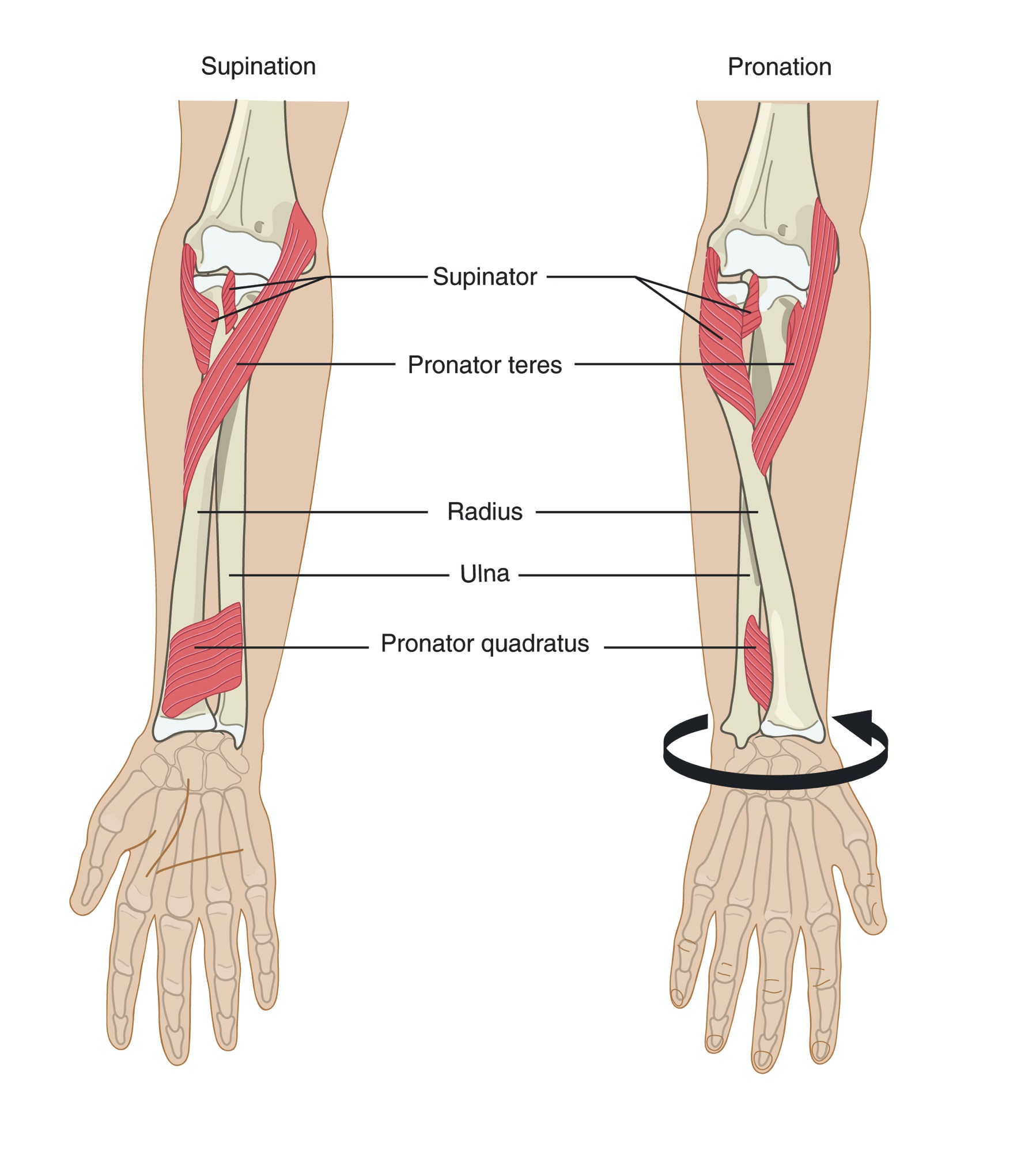
Traditional treatment targets the superficial muscles that bend and straighten the wrist, since those are the ones that hurt. My clinical model is that, in some stubborn cases, those superficial muscles are compensating for a deeper forearm-rotation problem. This idea seems to be supported now, many years later, by a small case series: patients with lateral elbow pain that hadn’t responded to standard treatment, injections, or ultrasonic tenotomy showed impaired supinator activation on ultrasound in every case, with the surface muscles compensating by overworking. Targeted supinator retraining resolved the pain in all three patients.3
One more thing I’ve noticed clinically: many people with elbow pain also have tenderness in the brachialis, a muscle that crosses the elbow from the upper arm. When I stretch the deep rotators, that tenderness often eases too. Whether that points to a broader inflammatory pattern in the joint or something else, I’m not certain.
Watch the video version
The self-test and stretch for tennis elbow and golfer’s elbow.
Why it’s not always just the elbow
I had a patient come in with golfer’s elbow — pain on the inside of the elbow. We stretched his deep forearm rotators, and the pain went away. Then it came back.
I went further up the chain and found very tight chest muscles pulling his arm bone into internal rotation. Stretching his forearm alone hadn’t accounted for the fact that half of his elbow joint, the upper arm bone, was also rotated excessively inward. Once we released the chest muscles, his arm bone sat in a better position, which meant his forearm rotators didn’t have to work nearly as hard to compensate. That’s when the pain actually stayed gone.
— Rick’s case notes
The humerus forms the upper half of the elbow joint, and its position is influenced by the shoulder. That’s why I check every elbow patient’s shoulder blade against the same landmarks I use for shoulder pain, and I check for a sidebending problem — the uneven pelvis and rib cage pattern I cover in full depth in my sciatica article. Sometimes the forearm is the main issue. Other times, the forearm is adapting to something happening farther up the chain.
A systematic review and meta-analysis supports this idea, finding measurable strength deficits in shoulder abduction and shoulder external rotation, along with weakness in the serratus anterior and lower trapezius, in people with lateral elbow tendinopathy compared to people without it.4 One proposed explanation is that proximal weakness changes how the upper limb distributes load, potentially increasing demands farther down the chain — consistent with what I see clinically when the shoulder gets ignored.
Watch
The chest-muscle case, and why elbow pain can climb the chain.
Testing your own forearm rotation
Try this test
How well does your forearm rotate?
- Stand with your elbows at your sides and thumbs pointing at the ceiling, palms facing each other with fingers open. Notice how close your elbows rest to your waist.
- Rotate your palms down toward the floor. Can you get a full 90 degrees, where the palm faces the floor? Did one or both elbows drift away from your side to help you get there?
- Return to the starting position with thumbs up, then rotate your palms up toward the ceiling. Same check: full 90 degrees, or do your elbows have to move into your waist to achieve it?
If either direction is limited, or your elbows have to work to hold their position while you rotate, or they move, that’s a sign your deep forearm rotators may be part of what’s limiting you. Many people are tighter rotating palms up than palms down.
Fixing it
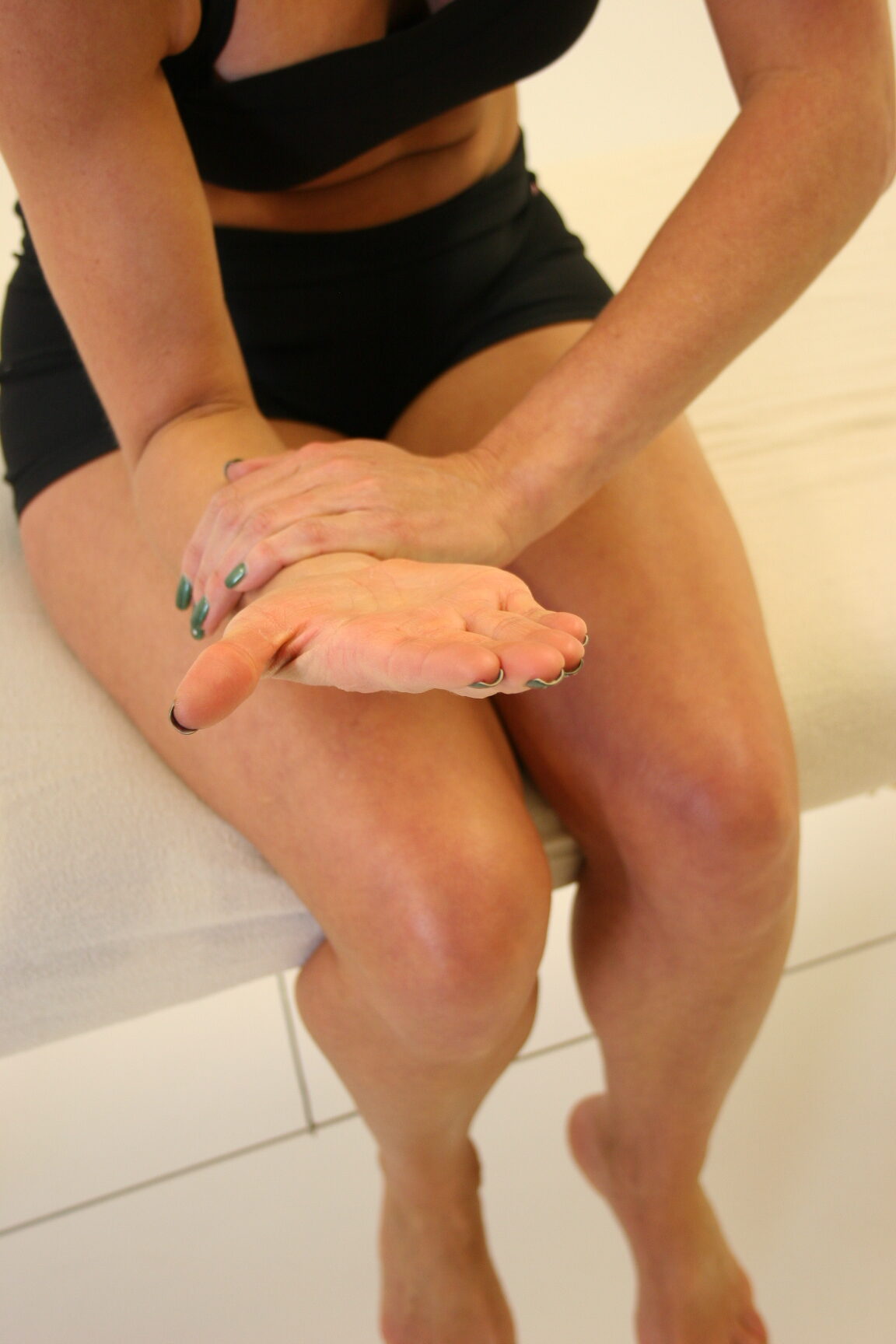
Rest your forearm on your lap or a table for stability. If your palms-up rotation was limited, use your other hand to gently assist the forearm a little farther into palm-up, staying well short of pain, and hold 30 to 60 seconds. If palms-down was the limited direction instead, do the same into palm-down. Either way, work the direction that was tight, not the direction that was already free.
Two ergonomic changes worth making
- Build up your chair’s armrests so your elbows are supported while you work. Unsupported elbows create constant tension in the whole arm.
- If you frequently use a mouse, move it closer to your body rather than reaching for it. An unsupported reaching arm feeds the same neck, shoulder, and elbow problems this whole series has been about.
If you found a shoulder blade or sidebending issue during your own check, those aren’t separate problems to solve later. All-Fours Rocking and Wall Slides, the two exercises I walk through in the shoulder article, are the same starting point here.
Putting it together
Trent’s forearm rotation was the visible problem, but his shoulder blade was what let it happen. The chest-muscle case looked like a forearm problem until it kept coming back, and turned out to be an arm bone stuck in internal rotation. The elbow was where the pain showed up. It wasn’t necessarily where the problem started.
Rick’s takeaway
When treating the sore spot only helps for a few days, that’s information, not failure. It usually means the sore muscle is compensating for something deeper — and in the elbow, that something is often rotation, not grip.
Common questions
Why isn’t my tennis elbow or golfer’s elbow going away with rest and ice?
Rest can reduce the load on an irritated tendon, and ice may temporarily reduce pain. But persistent tendinopathy isn’t simply an inflammatory condition. If a mechanical contributor, such as restricted forearm rotation, hasn’t changed, the tendon may continue to be exposed to the same stresses once you resume normal activity.
Why does massaging the sore spot only help temporarily?
In the pattern I often see, the sore superficial muscle is compensating for a deeper rotator that isn’t doing its job. Releasing the surface tension feels good briefly, but the deeper muscle is still tight and still forcing that compensation.
Can shoulder problems really cause elbow pain?
In my clinical experience, often, yes — the humerus is half of the elbow joint, and the shoulder controls the humerus. Research has also found shoulder and scapular strength deficits associated with lateral elbow tendinopathy, though that’s an association, not proof that fixing the shoulder alone resolves every case.
What if my elbow pain is one-sided?
You might want to check whether you also have a sidebending problem on that same side. An uneven pelvis and rib cage can change the position of the shoulder blade on one side, which may alter the mechanics farther down that arm. See my sciatica article for the full test.
Should I still see a doctor?
Yes. This isn’t a diagnosis or a substitute for medical care, especially if you have a specific traumatic injury, significant weakness, numbness, or symptoms that aren’t improving with conservative correction.
If you want the deeper explanation
The full forearm and elbow anatomy, testing, and progressions
Fixing You: Shoulder & Elbow Pain walks through the complete testing protocol and corrective exercise progressions behind everything in this article.
Fixing You: Shoulder & Elbow Pain
Want the systems-thinking framework behind all of this? Pain Patterns covers the same testing philosophy applied across the whole body.
Have a question this article didn’t answer?
Send it through the Ask Rick form. I read every question and use the most common ones to shape future articles, videos, and my monthly email — sometimes by featuring them, never with identifying details, in a public answer. I ask for your email in case I need more detail, or want to let you know when I’ve covered it.
References
- Multiple systematic reviews describe lateral epicondylitis as a degenerative tendinosis rather than an inflammatory process, despite the “-itis” naming convention. McCulloch C, Hunter MM, Lipp C, Lang E, Ganshorn H, Singh P. “Management of Lateral Epicondylitis Using Transdermal Nitroglycerin: A Systematic Review.” Cureus. 2022;14(12):e32560. ↩
- Briggs CA, Elliott BG. “Lateral epicondylitis. A review of structures associated with tennis elbow.” Anat Clin. 1985;7(3):149–153. Dissection of 139 cadaveric limbs found the extensor carpi radialis brevis tendon shares direct attachments with the supinator muscle, and that it reaches its greatest length and strain when the forearm is pronated with the wrist flexed, supporting a mechanically-induced model of tennis elbow. ↩
- Shimizu S, Kawabata M, Saito M, Omodani T. “Ultrasound-Guided Exercise Therapy Targeting the Supinator and Its Radial Nerve Branch for Refractory Lateral Elbow Pain: A Case Series.” Cureus. 2025;17(9):e92970. Three patients with lateral elbow pain that hadn’t resolved with injection or percutaneous ultrasonic tenotomy showed impaired supinator activation on ultrasound with compensatory overactivation of the extensor carpi radialis brevis and extensor digitorum. Supinator-targeted exercise therapy over 12–18 weeks resolved pain and substantially improved function scores in all three. ↩
- Heales LJ, Bout N, Dines B, Parker T, Reddiex K, Kean CO, Obst SJ. “An Investigation of Maximal Strength of the Upper Limb Bilaterally in Individuals With Lateral Elbow Tendinopathy: A Systematic Review With Meta-Analysis.” Phys Ther. 2021;101(12):pzab230. Found strength deficits in shoulder abduction and shoulder external rotation on the symptomatic side compared to asymptomatic controls, along with consistent evidence of serratus anterior and lower trapezius weakness. ↩